If you're a fan of court TV, or a lawyer, or enjoy seeing lawyers tormented, you might enjoy these bits of courtroom dialog, or at least be a bit disturbed. Here's a news story about the incident. For the best part of the dialog, though, you gotta watch the video. If your browser doesn't support the video directly, here is part 1 and here is part 2.
Thursday, August 31, 2006
How to become a dictator in a democracy
 Jacob C. Horberger has a great article on how Hitler became a dictator in a democracy. A key point came with the Reichstag fire, in which the German capitol building was burned down by a communist terrorist:
"The day after the [Reichstag] fire, Hitler persuaded President Hindenburg to issue a decree entitled, 'For the Protection of the People and the State.' Justified as a “defensive measure against Communist acts of violence endangering the state,” the decree suspended the constitutional guarantees pertaining to civil liberties..."
Specifically Hindenburg (not Hitler) declared that the government could restrcit civil liberties "beyond the legal limits otherwise prescribed." This was the first step to dictatorship, the Reichstag Fire Decree. The second step was the Enabling Act, which destroyed separation of powers by giving the executive branch legislative power. It was only supposed to be temporary, until the government had dealt with the terrorist threat.
 This was hardly the only time in history a republic or democracy has been converted
 by a perceived or actual emergency or war into a dictatorship. The examples are numerous, but perhaps two more major ones suffice: the 1917 October Revolution destroyed the shaky parliamentary government of Kerensky with the dictatorship of Lenin. Dispute over the legal powers of officials and ensuing civil war turned the Roman Republic into the Roman Empire.


Monday, August 28, 2006
Why the housing inflation?

What has caused the recent and unprecedented housing inflation, rendering houses less affordable in the U.S. than they've been for over a century? Almost surely the answer is the recent rapid increase in zoning and code regulations, driven by coalitions of homeowners under the aegis of Baby Boomer environmentalist and smart growth ideology. Much of the extra costs go to "architects" who must be paid to approve both new housing and additions, but much also come from severe restrictions, for example on height, and from vast areas of land simply being put off-limits to housing. The result is a large benefit to homeowners who sell or get equity loans, but an even larger loss to non-owners who would like to purchase, including millions of people stuck in substandard or cramped housing and over a million outright homeless.
This study, among many other studies and observations, shows a strong correlation between local regulations and local housing prices. The correlation between housing prices and other plausible variables, such as density, is by contrast relatively weak. A reaction which purports to solve the housing costs problem, while actually making it worse, is inclusionary zoning, which more than tripled in California between 1990 and 2003.
See also my previous post on rent-seeking coalitions at the national level.
(Click to enlarge. The following graphs come from the above-cited study).


Saturday, August 26, 2006
"Do you think government is too big, too powerful?"
Yes, I do, I say readily. Of course, I'm not being interrogated after losing an iPod down an airplane toilet. I'm not normally a big fan of FDR, but "we have nothing to fear but fear itself" seems rather apropos.
Friday, August 25, 2006
Pollution reduction with cap & trade
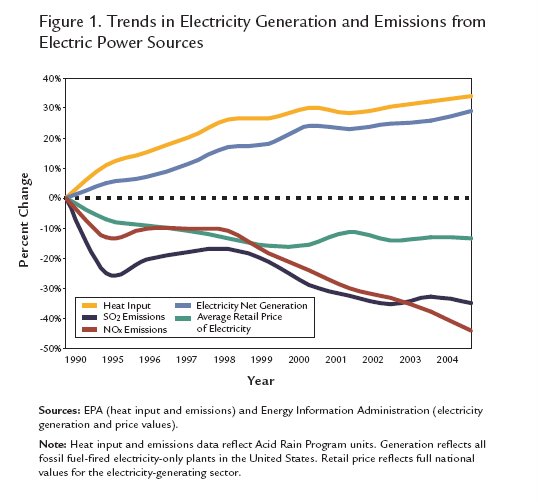
The EPA has an interesting report on the cap-and-trade programs for acid rain pollutants. These markets have led to dramatic reductions in the pollutants while costing industry (and therefore consumers) relatively little. This is reflected by the fact that electricity prices have also fallen since the advent of the acid rain pollution markets. Anybody who is serious about reduction of large-scale pollution from large sources sees cap and trade as the leading method of reduction. The program has been so successful the EPA has been able to set new ambitious goals of reducing sulfates by a further 70% and nitrates by a further 60% without serious objection from Republicans.
The next big challenge is carbon dioxide, the probable main cause of global warming. The European Union Emission Trading Scheme is the first stab at this. According to critics the European authority has given away too many grandfathered credits and bought too few back, causing the price to decline too far and, allegedly, too few actual emissions reductions to be implemented. While emission markets themselves work remarkably well, where the actual cap of emissions should be set remains a political hot button. Fortunately, the pollution market also makes it far easier to far more accurately estimate cost-benefit ratios, thus greatly informing the political debate.
Besides the cap level, the most interesting debate is over auctions versus grandfathering for allocating the initial rights. While the U.S. acid rain market achieved great results with grandfathering the initial credits, it's probable that emissions markets would work even better by auctioning off the inititial credits rather than giving them away based on current emissions. Grandfathering creates an incentive for polluters to increase their emissions in the years befor the grandfathering levels are determined. On the other hand, there's an argument to be made that current emitters have by their legal operations developed prescriptive rights to their current levels of emissions, and the acid rain markets have demonstrated that grandfathering works.
The U.S. market also shows that it takes some time to develop these market institutions. An initial dry-run period which focuses more on developing the market and monitoring institutions rather than steep carbon dioxide reductions is probably a good idea. Once the institutions have evolved into an efficient form dramatic reductions in carbon dioxide emissions from large sources will likely be possible, as indicated by the EPA now being able target dramatic reductions after a decade of acid rain emissions trading.
The third interesting issue is whether to include third party carbon dioxide sinks in the market. This would be a novelty not yet tried in other pollution markets, but it makes quite a bit of sense since we don't really know yet whether emissions reduction or creating carbon dioxide sinks is the better strategy for carbon dioxide reduction. The market should motivate both solutions. But measuring the amount of carbon dioxide sunk, and determining for how long a period into the future it must be sunk for, are among the novel issues to be addressed.
The fourth issue, crucial to getting carbon dioxide markets to actually cut back the rising global emissions, is to extend them to other developed countries and, most challenging of all, to developing countries.

Thursday, August 24, 2006
Colliding galaxy clusters show dark matter
 Astronomers have now observed dark matter separate itself out from normal matter. Normally dark matter and ordinary matter are too well mixed to observe separately. However, when galaxy clusters collide at high velocity (the cloud observed here was produced by a 4,700 kilometer per second collision) ordinary and dark matter can become separated.
In this research, the position of hot gas (ordinary matter) in a vast odd cloud resulting from such a collision was measured with an x-ray telescope. The center of gravity of the combined ordinary and dark matter was observed by measuring its gravitational lensing effect on bright galaxies behind the cloud with an optical telescope. The difference between the two positions showed that the dark matter (which normally outweighs ordinary matter 6 to 1) had become separated from the ordinary matter.
The leading explanation for the separation is that the dark matter doesn't experience drag from electromagnetic forces -- it only reacts to gravity -- and thus doesn't get as perturbed from a collision as ordinary matter.
The image above shows dark matter positioned as indicated by gravitional lensing (blue) painted onto the optical image. This video shows a simulation of galaxy clusters made out of dark matter (blue) and ordinary matter (red) colliding and producing such a cloud. More here.
Astronomer Sean Carroll says this research "proves beyond a reasonable doubt" that dark matter exists. I love it when scientists talk my language. :-)
Wednesday, August 23, 2006
Patents: the coming obviousness showdown
The most notorious feature of the U.S. patent system is the current test for obviousness. On top of being "novel," patents are supposed to be "non-obvious." The novelty test is relatively straightforward: nobody must have previously described a device that has all the elements of the disputed patent claim. Thus, if A+B, B, and C have already been made or described, then A+B+C and B+C are novel but A+B is not.
In order to not bother people with trivial combinations, patent law has longed deemed that on top of novelty there be an "inventive step," which in the U.S. now goes under the name of "non-obviousness." To the Supreme Court in the 1950s, this meant that a patent claim must demonstrate "the extraordinary level of innovation, beyond the capabilities of a person having ordinary skill in the art, that warrants the award of a patent." This expressed most engineers' aspirations about what a true invention consists of, but it was notoriously subjective, leading to arbitrary decisions by patent examiners and courts. To create a more objective test, in the 1970's the Supreme Court held that a new combination which did not change the respective functions of at least some of the elements was obvious.
Then Congress created the Federal Circuit and granted it a virtual monopoly over patent appeals. The Federal Circuit proceeded to radically change patent law in a variety of areas, usually in favor of the patent seeker or holder. Until this most recent term, the Supreme Court has largely let it do so. But now, first with eBay and now with this obviousness case (KSR v. Teleflex), the Supreme Court is starting to rein it in.
Among the law the Federal Circuit changed, it made the obviousness test far more difficult for a patent examiner or alleged infringer to prove, but also made the test far more objective and straightforward. To be obvious, according to the Federal Circuit, there must be a teaching, suggestion, or motivation in prior literature that would have led a person of ordinary skill in the art (i.e. your typical engineer in the particular field) to have made the claimed combination. For the purposes of this counterfactual test it is assumed that this hypothetical engineer had all relevant prior art pasted on the walls of his office. The teaching or suggestion doesn't have to be a full-fledged description of a combination of the elements, as in novelty, but in practice the infringer almost has had to prove a lack of novelty in order to prove a lack of obviousness, rendering the obviousness test almost superfluous and leading to the raft of trivial patents engineers complain of these days.
I'm proud to say that the professors of two of the best patent classes I took in law school are leading the charge to overturn the Federal Circuit's obviousness test. John Duffy is co-counsel for the petitioner, KSR, which is challenging the Federal Circuit law. Robert Brauneis is Counsel of Record for the 24 Law Professors as friends of the Court who support reforming the obviousness test. These are two very talented individuals and I predict a splendid success.
KSR in its brief argues that the Supreme Court's test(s) should be restored, but it gives short shrift as to what specifically the test of obviousness should be. If you have good idea(s) for what the test(s) for obviousness should be, now is the time to let us know.
Patently Obvious has more discussion of the issue and links to all the various briefs.
In order to not bother people with trivial combinations, patent law has longed deemed that on top of novelty there be an "inventive step," which in the U.S. now goes under the name of "non-obviousness." To the Supreme Court in the 1950s, this meant that a patent claim must demonstrate "the extraordinary level of innovation, beyond the capabilities of a person having ordinary skill in the art, that warrants the award of a patent." This expressed most engineers' aspirations about what a true invention consists of, but it was notoriously subjective, leading to arbitrary decisions by patent examiners and courts. To create a more objective test, in the 1970's the Supreme Court held that a new combination which did not change the respective functions of at least some of the elements was obvious.
Then Congress created the Federal Circuit and granted it a virtual monopoly over patent appeals. The Federal Circuit proceeded to radically change patent law in a variety of areas, usually in favor of the patent seeker or holder. Until this most recent term, the Supreme Court has largely let it do so. But now, first with eBay and now with this obviousness case (KSR v. Teleflex), the Supreme Court is starting to rein it in.
Among the law the Federal Circuit changed, it made the obviousness test far more difficult for a patent examiner or alleged infringer to prove, but also made the test far more objective and straightforward. To be obvious, according to the Federal Circuit, there must be a teaching, suggestion, or motivation in prior literature that would have led a person of ordinary skill in the art (i.e. your typical engineer in the particular field) to have made the claimed combination. For the purposes of this counterfactual test it is assumed that this hypothetical engineer had all relevant prior art pasted on the walls of his office. The teaching or suggestion doesn't have to be a full-fledged description of a combination of the elements, as in novelty, but in practice the infringer almost has had to prove a lack of novelty in order to prove a lack of obviousness, rendering the obviousness test almost superfluous and leading to the raft of trivial patents engineers complain of these days.
I'm proud to say that the professors of two of the best patent classes I took in law school are leading the charge to overturn the Federal Circuit's obviousness test. John Duffy is co-counsel for the petitioner, KSR, which is challenging the Federal Circuit law. Robert Brauneis is Counsel of Record for the 24 Law Professors as friends of the Court who support reforming the obviousness test. These are two very talented individuals and I predict a splendid success.
KSR in its brief argues that the Supreme Court's test(s) should be restored, but it gives short shrift as to what specifically the test of obviousness should be. If you have good idea(s) for what the test(s) for obviousness should be, now is the time to let us know.
Patently Obvious has more discussion of the issue and links to all the various briefs.
Colonialism just ain't what it used to be
1891, British armed forces stationed in (undivided) India: 90,666
Population of undivided India: 287, 223, 431
Number of Indians per British soldier: 3,168
2006, American troops stationed in Iraq: c. 150,000
Population of Iraq: 26,074,906
Number of Iraqis per American soldier: 174
More here. The ratio of Indians to soldiers of British origin was even higher under the old British East India Company. Furthermore, even though the British East India Company, and later the British Crown, unified and controlled and radically changed the government of India, British civil service in India "had a maximum strength of little more than a thousand," according to Niall Ferguson's colorful book Empire.
It's no longer our highly educated and culturally unified mercenaries taking sides in wars between badly divided and largely illiterate native polities, as during the colonial era. National sympathies, stemming mainly from ties of a written language and shared religion, now unify millions of people at a time into cohesive, educated, and highly motivated political blocs that we try to control at our peril. The sophisticated communications and financial networks such nations set up (even if they are stateless) cannot be disrupted for long. A small subset of such megagroups who have particularly strong views can, on the other hand, now severly disrupt traditional occupation and traditional government.
It's not now and never was a problem of "not enough troops on the ground." We are already deploying far more troops in Iraq than is historically normal for a successful overseas occupation. If we continue to try to play Empire, or even just world policeman, it will destroy us.
Tuesday, August 22, 2006
What was the Coalition Provisional Authority?
The Coalition Provisional Authority (CPA) governed Iraq between April 2003 and June 2004. Despite the governmental powers it wielded, its legal nature is "shrouded in ambiguity," according to federal district court Judge T.S. Ellis III. This Congressional Report concurs.
The issue made it to court due to a lawsuit against various CPA contractors. The issue was whether the CPA was a U.S. federal agency, and thus the CPA's contractors federal government contractors. Judge Ellis held that the plaintiffs could not prove that they were. (Incidentally, some of these contractors, such as Custer Battles LLC, are also interesting entities: private companies apparently wielding some governmental and military powers delegated from the CPA. But that will have to be a subject for another time. First we have to figure out what the authority was that CPA had to grant).
Was the CPA created by President Bush as a separate federal agency in a National Security Directive? Was it a division of the United States Department of Defense as the Department of Justice now argues? Was it a United Nations agency created pursuant to a U.N. Security Council directive? Was it as Paul Krugman calls it a "private fiefdom"? Was it a private contractor wielding today's version of the colonial franchise? Was it a government created by a secret charter? (Imagine if the U.S. Constitution was a state secret. I can't do it, but let's try). Or -- most likely of all -- was it simply an ad-hoc creation based on no good legal procedure whatsoever? According to Judge Ellis, "....there is no formal document – whether statute, United Nations Security Council resolution, or other organic document – that plainly establishes the CPA or provides for its formation." The Congressional report agrees: " Detailed information that explicitly and clearly identifies how CPA was established, by whom, and under what specific authority, is not readily available."
The CPA's direct predecessor in governing Iraq was the Office of Reconstruction and Humanitarian Assistance (ORHA). The ORHA is the product of the still-classified National Security Presidential Directive (NSPD) 24 in January 2003. Its first head, retired Lieutenant General Jay Garner, was apparently hired by the Secretary Defense. A news story stated that he would report to the commander of the U.S. Central Command, who was at the time General Tommy Franks. But Garner's position description stated:
NPSD 36 in May 2004 retroactively defined the CPA as a "temporary organization" under 5 U.S.C. § 3161. But it is still unknown under what "law or Executive order," if any, the CPA was established so as to qualify as a "temporary organization."
In a report to Congress the Office of Management and Budget stated the following:
Under the principle of conservation of rights, the President could not grant any more authority than he himself possessed under law. But that's an interesting side issue.
 If indeed the Adminstrator of the CPA "reports to" the Secretary of Defense, this suggests a principle-agent or employment relationship rather than a property relationhip (the owner of one property does not "report to" another). So that rules out a true private franchise (or, as Paul Krugman crudely and naively puts it in today's New York Times, a "private fiefdom") as a theory. Thus it wasn't as independent as the typical British colonial corporation. That doesn't rule out some other kind of contracting relationship, however, or just a DoD internal hierarchy, either of which could be at least as or more corrupt than a so-called "fiefdom." There was never any such legal entity as a "fiefdom," by the way -- the term is a figment of non-legal historians' imaginations and of uncritical readers of history like Paul Krugman.
Of course the Brits, still playing Empire, chimed in to say that they, too, helped set up the CPA in this letter to the United Nations:
Democracy spread to America, not in the form of a central government bureacracy, and certainly not in the form of a military authority, but in the form of colonial companies whose charters preserved for residents our "English liberties." If we use franchises, however, we need to use them openly, and we need to revive the limitations we imposed on them -- especially the ability of victims of their abuses to sue in royal courts (for the U.S. that would be federal courts), especially for violations of the kinds of procedural rights now found in the U.S. Bill of Rights and the international Geneva Conventions regarding war.
Meanwhile, we should have no secret charters. How much freedom would we have under the U.S. Constitution if it were secret? How well would our "English liberties" have been preserved in the American colonies, and the institutions of democracy developed, if our charters had been secret? How accountable would such a government be? NPSD 24 should be declassified immediately, and no secret charter should be considered to have any legal authority by any government official or any other citizen any time in the future.
The issue made it to court due to a lawsuit against various CPA contractors. The issue was whether the CPA was a U.S. federal agency, and thus the CPA's contractors federal government contractors. Judge Ellis held that the plaintiffs could not prove that they were. (Incidentally, some of these contractors, such as Custer Battles LLC, are also interesting entities: private companies apparently wielding some governmental and military powers delegated from the CPA. But that will have to be a subject for another time. First we have to figure out what the authority was that CPA had to grant).
Was the CPA created by President Bush as a separate federal agency in a National Security Directive? Was it a division of the United States Department of Defense as the Department of Justice now argues? Was it a United Nations agency created pursuant to a U.N. Security Council directive? Was it as Paul Krugman calls it a "private fiefdom"? Was it a private contractor wielding today's version of the colonial franchise? Was it a government created by a secret charter? (Imagine if the U.S. Constitution was a state secret. I can't do it, but let's try). Or -- most likely of all -- was it simply an ad-hoc creation based on no good legal procedure whatsoever? According to Judge Ellis, "....there is no formal document – whether statute, United Nations Security Council resolution, or other organic document – that plainly establishes the CPA or provides for its formation." The Congressional report agrees: " Detailed information that explicitly and clearly identifies how CPA was established, by whom, and under what specific authority, is not readily available."
The CPA's direct predecessor in governing Iraq was the Office of Reconstruction and Humanitarian Assistance (ORHA). The ORHA is the product of the still-classified National Security Presidential Directive (NSPD) 24 in January 2003. Its first head, retired Lieutenant General Jay Garner, was apparently hired by the Secretary Defense. A news story stated that he would report to the commander of the U.S. Central Command, who was at the time General Tommy Franks. But Garner's position description stated:
This Office [ORHA] is established at the direction of the President of the United States, and is located for administrative purposes under Boards, Commissions and Task Forces, Washington Headquarters Services. This Office is under the supervision of the Under Secretary of Defense for Policy.Garner's tenure was short-lived as the OHRA was within two months replaced by the CPA:
On May 13, 2003, the Secretary of Defense designated Ambassador Bremer as CPA Administrator. The first regulation issued by Ambassador Bremer, dated May 16, 2003, identified him as Administrator of CPA. The authority’s Inspector General (IG) stated, in his initial report to Congress, that OHRA became CPA in May 2003. However, a March 2004 DOD IG report stated that the Deputy Secretary of Defense, in a June 16, 2003, memorandum, dissolved ORHA and shifted ORHA’s functions, responsibilities, and legal obligations to CPA.The senior officials of the CPA were various active and retired U.S. military officers, U.S. ambassadors, and a liason from the U.S. Agency for International Development (USAID).
NPSD 36 in May 2004 retroactively defined the CPA as a "temporary organization" under 5 U.S.C. § 3161. But it is still unknown under what "law or Executive order," if any, the CPA was established so as to qualify as a "temporary organization."
In a report to Congress the Office of Management and Budget stated the following:
The Administrator of the Coalition Provisional Authority (CPA) reports to the President through the Secretary of Defense. He oversees, directs and coordinates all U.S. Government (USG) programs and activities in Iraq, except those under the command of the Commander, U.S. Central Command (CENTCOM)... The CPA is vested by the President with all executive, legislative and judicial authority [i.e. governmental power] necessary to achieve its objectives, exercised consistent with relevant U.N. Security Council resolutions, including [U.N. Security Council] Resolution 1483,32 and the laws and usages of war. The CPA Administrator has primary responsibility for exercising this authority."The CPA is vested by the President with all executive, legislative, and judicial authority..." sounds very much like the language of Britain's colonial charters. But it subsitutes "vest" for "grant" (I'm not sure what thelegal implication of that might be) and lacks anything like the very redeeming feature of the American colonial charters that reserved rights to their "English liberties" for the residents of the granted area -- one of the main origins of the United States' Bill of Rights. Only the "laws and usages of war" seem to have restricted the CPA under the charter language reported here. This is more like the charter of the Royal Guinea Company that granted said corporation martial law power so that the company would have a free hand to defend its taking of slaves. To be fair, the United States was fighting a war, and the CPA unlike the Guinea Company was temporary and not, as far as I know, taking slaves.
Under the principle of conservation of rights, the President could not grant any more authority than he himself possessed under law. But that's an interesting side issue.
 If indeed the Adminstrator of the CPA "reports to" the Secretary of Defense, this suggests a principle-agent or employment relationship rather than a property relationhip (the owner of one property does not "report to" another). So that rules out a true private franchise (or, as Paul Krugman crudely and naively puts it in today's New York Times, a "private fiefdom") as a theory. Thus it wasn't as independent as the typical British colonial corporation. That doesn't rule out some other kind of contracting relationship, however, or just a DoD internal hierarchy, either of which could be at least as or more corrupt than a so-called "fiefdom." There was never any such legal entity as a "fiefdom," by the way -- the term is a figment of non-legal historians' imaginations and of uncritical readers of history like Paul Krugman.
Of course the Brits, still playing Empire, chimed in to say that they, too, helped set up the CPA in this letter to the United Nations:
In order to meet these objectives and obligations [disarming Iraq and providing for the humanitarian needs of Iraqis] in the post-conflict period in Iraq, the United States, the United Kingdom and Coalition partners, acting under existing command and control arrangements through the Commander of Coalition Forces, have created the Coalition Provisional Authority, which includes the Office of Reconstruction and Humanitarian Assistance, to exercise powers of government temporarily, and, as necessary, especially to provide security, to allow the delivery of humanitarian aid, and to eliminate weapons of mass destruction.The CPA's status was also a matter of PR:
Of course Congress' biggest concern of isBilling itself as an international coalition, while eschewing the label “federal agency,” might be construed as an effort to make the organization more palatable, at least symbolically, to Iraqis and others. For example, the CPA website address ended “.com” and the PMO website ended “.net.” United States government website addresses typically end “.gov.” Furthermore, the Iraqi flag is the only flag that appeared on the two websites. No flags from coalition countries were displayed.
Further compounding the problem, oversight initiatives might have been met with theresponse that the activity in question was carried out under an authority over which the oversight body — Congress — had no jurisdiction.
Shades of Parliament declaring oversight authority over the American Colonies? (That was the main legal issue of the American Revolution, I hope my U.S. readers recall). It's better than the leading alternatives of unaccountable Presidential authority or United Nations authority, I suppose. And unlike Parliament's claim it is presumably like the CPA a temporary one.
The Congressional report concludes that "[t]he status of this organization remains open to question." It suggests that the CPA has a "capacity as an entity of the United State government" but that it also had "other roles." That means that the CPA was able to operate with more flexibility and less accountability: "[p]ossibly, the mix of arrangements allowed CPA to operate with greater discretion and more authority, and have access to more resources, than if it had been solely a federal agency, or an arm of the United Nations."I couldn't agree more. But I'd add the following: bureaucratic hierarchy is not the be-all and end-all of government, nor is Congressional oversight, especially when the people being governed (here the Iraqis) are not voting for said Congress. (No taxation without representation, remember?) Just as the printing press era led to substantial reorganization and the rise of bureacracy, so the era of Internet consciousness and asymmetric warfare may lead to the rise of new, and the recreation of the best of old, alternatives to a command-and-control bureaucracy for basic governmental functions. Franchise government -- the colonial corporation and its subsets -- probably has a valuable role to play if we insist on conducting "democracy building" operations overseas. The crude recapiulation of this form (alas, sans most of the legal protections that historically accompanied it) in the form of the CPA and its contractors suggests that the franchise form is indeed re-emerging.Available information about the authority found in materials produced by the Administration alternatively (1) denies that it was a federal agency; (2) states that it was a U.S. government entity or instrumentality; (3) suggests that it was enacted under United Nations Security Council Resolution 1483; (4) refers to it, and OHRA, as “civilian groups ... reporting to the Secretary [of Defense]”;143 (5) states that it was created by the United States and United Kingdom; and (6) asserts that it was established by the then-Commander of CENTCOM. Without a clear, unambiguous statement that declares the CPA’s organizational status, clarifies what its relationship was with DOD and other federal agencies, and addresses the competing explanations for how it was created, various questions are left unanswered, including whether, and to what extent, CPA might be held accountable for its programs, activities, decisions, and expenditures.
Democracy spread to America, not in the form of a central government bureacracy, and certainly not in the form of a military authority, but in the form of colonial companies whose charters preserved for residents our "English liberties." If we use franchises, however, we need to use them openly, and we need to revive the limitations we imposed on them -- especially the ability of victims of their abuses to sue in royal courts (for the U.S. that would be federal courts), especially for violations of the kinds of procedural rights now found in the U.S. Bill of Rights and the international Geneva Conventions regarding war.
Meanwhile, we should have no secret charters. How much freedom would we have under the U.S. Constitution if it were secret? How well would our "English liberties" have been preserved in the American colonies, and the institutions of democracy developed, if our charters had been secret? How accountable would such a government be? NPSD 24 should be declassified immediately, and no secret charter should be considered to have any legal authority by any government official or any other citizen any time in the future.
A disturbing new beast
Cancer cells have been discovered that escaped from their hosts and evolved into contagious parasites.
Conservation of rights
Under the first sale rule, a patented or copyrighted work can be resold without the permission of the patent or copyright holder. For example, if you buy a book you can give it away or resell it without getting permission from the publisher, even if the book contains a copyright notice that purports to forbid this. Similarly, if you buy a patented widget, you can generally resell it without the permission or against the objections of the patent owner. The first sale is said to exhaust the rights of the patent holder over that object.
The Federal Circuit court in the United States has held that for patents the first sale rule does not apply to copies, including seeds based on purchase of the parent seed:
This latter is based on a general principle of the common law of property: you can't grant more than you own. There is an interesting exception to this principle for financial property (negotiable instruments).
The idea at work here might be called a conservation of property rights: you can't sell what you don't own and you can't take back what you have sold. It is a sensible principle that greatly simplifies the legal relationships we have with each other. However, this case, and some other recent cases providing for exceptions to the first sale rule, seems to give rise to a new and odd violation of rights conservation. A patent owner can lose its rights over an object, but later they can re-appear again. Here, the patent owner Monsanto lost its residual rights of control over the seeds when it sold them, via the first sale doctrine. But then, when the farmer grew the seeds and planted the daughter seeds, the patent owner's rights suddently re-appeared.
For the case of seeds, this paradox can be resolved by treating the daughter seeds as separate objects from the parent seeds. Under this view, what the farmer was doing was the equivalent of manufacturing new widgets rather than simply repairing the same widget (which would not require the patent owner's permission under U.S. law).
A more disturbing violation of rights conservation occurs in the issue of national versus international first sale exhaustion. Many countries have a simple rule: the first sale of an object by a patent owner anywhere in the world exhausts that owner's patents covering the object in that country. This was also the view in the majority of federal circuit courts in the U.S. before creation of the Federal Circuit and its monopoly over patent law.

Earlier this year the Federal Ciruit in the Jazz Photo took a different view. Now if you buy, for example, a widget in Japan, paying royalties to the Japanese patent owner in Japan, and then export the widget to the U.S., you still need permission of the U.S. patent owner (usually the very same person with the same kinds of patent claims as the Japanse patent owner). The patent owner's rights over that object disappear upon first sale in Japan but magically re-appear when the object crosses the border into the U.S. This can only be reconciled with conservation of rights by the idea that that the Japanese patent is a different property right than the United States patent, even though they are owned by the same person and protect the same invention. It is as if you drove your car from Virginia to Maryland and the dealer you bought it from came along and repossessed it, because your Virginia title did not give you Maryland title. That would be a very strange and unfortunate world. It is far simpler, and makes for much more secure property rights, to treat property rights as universally conserved even though they are titled by a local authority.
The Federal Circuit court in the United States has held that for patents the first sale rule does not apply to copies, including seeds based on purchase of the parent seed:
The fact that a patented technology can replicate itself does not give a purchaser the right to use replicated copies of the technology. Applying the first sale doctrine to subsequent generations of self-replicating technology would eviscerate the rights of the patent holder.Furthermore, the Federal Circuit held that the farmer had no implied license to use the daughter seeds, because Monsanto's license to the wholesaler restricted this use and "a seller cannot confer broader rights via an implied license than it has been granted by the patent holder."
This latter is based on a general principle of the common law of property: you can't grant more than you own. There is an interesting exception to this principle for financial property (negotiable instruments).
The idea at work here might be called a conservation of property rights: you can't sell what you don't own and you can't take back what you have sold. It is a sensible principle that greatly simplifies the legal relationships we have with each other. However, this case, and some other recent cases providing for exceptions to the first sale rule, seems to give rise to a new and odd violation of rights conservation. A patent owner can lose its rights over an object, but later they can re-appear again. Here, the patent owner Monsanto lost its residual rights of control over the seeds when it sold them, via the first sale doctrine. But then, when the farmer grew the seeds and planted the daughter seeds, the patent owner's rights suddently re-appeared.
For the case of seeds, this paradox can be resolved by treating the daughter seeds as separate objects from the parent seeds. Under this view, what the farmer was doing was the equivalent of manufacturing new widgets rather than simply repairing the same widget (which would not require the patent owner's permission under U.S. law).
A more disturbing violation of rights conservation occurs in the issue of national versus international first sale exhaustion. Many countries have a simple rule: the first sale of an object by a patent owner anywhere in the world exhausts that owner's patents covering the object in that country. This was also the view in the majority of federal circuit courts in the U.S. before creation of the Federal Circuit and its monopoly over patent law.

Earlier this year the Federal Ciruit in the Jazz Photo took a different view. Now if you buy, for example, a widget in Japan, paying royalties to the Japanese patent owner in Japan, and then export the widget to the U.S., you still need permission of the U.S. patent owner (usually the very same person with the same kinds of patent claims as the Japanse patent owner). The patent owner's rights over that object disappear upon first sale in Japan but magically re-appear when the object crosses the border into the U.S. This can only be reconciled with conservation of rights by the idea that that the Japanese patent is a different property right than the United States patent, even though they are owned by the same person and protect the same invention. It is as if you drove your car from Virginia to Maryland and the dealer you bought it from came along and repossessed it, because your Virginia title did not give you Maryland title. That would be a very strange and unfortunate world. It is far simpler, and makes for much more secure property rights, to treat property rights as universally conserved even though they are titled by a local authority.
Subscribe to:
Posts (Atom)