This month has thrown off quite a bit of new information on Neanderthals and on the possibility that they interbred with some of the humans that came out of Africa. It's bound to stir up controversy.
The first interesting recent study comes from extracting the remains of a probable Neanderthal DNA from 38,000 years ago, copying it into bacteria, and then sequencing it at leisure. (Query: do fundamentalists oppose this procedure as a forbidden "cloning of a human"?). This bacterial-Neanderthal chimera (actually, the Neanderthal genes are really just junk DNA from the point of view of the normally functioning bacteria) is an improvement over the traditional technique that apparently destroys the original DNA in the process of sequencing it. Preserving the DNA is vital for this application: Neanderthal DNA has been severely damaged by 38,000 years of chemistry and can only be obtained with severe difficulty in small fragments.
Large-scale statistical studies from these probable Neanderthal sequences suggest that the number of genes we moderns derive from Neanderthals is few, if any. In other words, all of us trace either nearly all or entirely all of our ancestry from homo sapiens originating in Africa c. 200,000 years ago rather than to Neanderthals that originated some 700,000 years ago. Pretty much what most scientists have thought for the last few decades.
However, that does not mean humans and Neanderthals didn't interbreed, and it doesn't mean that none of us got any important genes from them. There is some fossil evidence from Portugal and Romania suggesting human-Neanderthal hybrids. Even more startling is a study published this month showing that about 70% of modern humans possess a gene for brain development (this paper goes straight for the controversy jugular!) derived from an "archaic species of homo" rather than from our African homo sapiens ancestor. Since the time of "introgression" (cross-breeding between the archaic species and the African-derived modern species, homo sapiens) was about 37,000 years ago, and the gene is overly represented in Europe and Asia but uncommon in sub-Saharan Africa (I warned you about controversy!), it's a good guess that this gene was a "gift" from a sneaky Neanderthal to the second wave of modern humans to have left Africa, the ancestors of most modern Europeans and Asians. A gift that was positively selected -- it replaced its African-derived alternative almost everywhere they were in competition -- and with which most of us are now blessed. The Neanderthal DNA sequencing study shows that the African genes won the vast majority of the other competitions.
Monday, November 27, 2006
Sunday, November 26, 2006
Are green beards ubiquitous?
 This is a post is for those of you who are fellow fans of evolutionary theories of behavior.
A genetic strategy has been postulated by evolutionary theorists such as William Hamilton and dubbed by Richard Dawkins the "green beard effect." This effect has been observed in nature, though only rarely has it been clearly distinguished from other recognize-and-discriminate systems.
Green beard genes are genes (or more likely small sets of linked genes) that code for the recognition of their presence in other individuals along with discriminatory favoritism of those individuals. Kin altruism, although quite common and treated in this article as a distinct effect, can be thought of as a special case of the green beard effect. In kin altruism genes "recognize themselves" only in probabalistic assemblages, i.e. by degree of kinship (your children and siblings are guaranteed to share 1/2 of your uncommon mutations, nieces and nephews and grandchildren are 1/4 related to you, etc. Note that we are counting new and thus still uncommon mutations, not stable genes: the important question is what will favor or disfavor new mutations. Evolutionary pressure takes ubiquitous genes for granted).
"Green beard" is a misleading name as it has led scientists to look for blatant signals, but as I argue below the effects are much more likely to be subtle and parasitical on other kinds of recognition systems. (I don't know to what extent, if any, the following "green beard"/"blue beard" theory of mine is original, as I haven't thoroughly researched this literature and the theory is at least partially suggested by the papers I have read and cite here). Most evolutionary scientists have thought green beard effects would be rare because they have generally not found such blatant signals associated with clear green beard effects and because green beard effects require the simultaneous appearance of three distinct yet genetically linked traits:
(1) a detectable feature of the phenotype,
(2) the ability to recognize this feature (or the lack of it) in others, AND
(3) different behavior towards individuals possessing the feature versus those not
This argument for green beard rarity is flawed, because a wide variety of recognition systems already exist that can readily give rise to green beard genes, some of the main ones being:
+ gender recognition and sexual selection (the tendency to prefer some characteristics in mates and avoid others)
+ conspecific recognition (distinuishing own species from others)
+ kin recognition for kin altruism
+ maternal recognition of self vs. fetus
 Let's call these "normal" recognition systems "blue beards." They are just as blatant or subtle as signals as "green beards." Any recognition system is imperfect: it is coded for by only some of the genes it benefits, and some of these genes will be more strongly linked than others. The more strongly linked genes automatically favor each other: they are green beard genes. Thus, almost any recognize-and-distriminate system can be expected to give rise to the following green beard cycle:
(1) green beard genes arise within an existing recognize-and-discriminate system (the blue beard genes) and spread in the population,
(2) as the green beard genes spread, the recognition system becomes noisier for unlinked (blue beard) genes,
(3) the noise has enough negative impact on unlinked blue beard genes (beneficiaries of the original recognition system) that the blue beard genes develop modifiers to suppress the green beards.
Alternatively, the green beard genes might have only a slightly deleterious effect on unlinked genes and thus might succeed. Consider the following hypothetical: a recognition system in a hypothetical cuckoo, a brood parasite, is under genetic pressure to favor blue or green tufts as these are the best ways (and blue is slightly better than green) for our hypothetical cuckoos as adults to recognize each other as distinct from their host species' adults which are red. The gene coding for the green tuft, however, is linked to the recognize-and-discriminate genes while a different gene coding for the blue tuft is unlinked. The green beard effect favors the green tuft even though is is slightly worse than the blue tuft as a signal recognition device.
A similar effect might help explain runaway sexual selection for expensive features such as peacock tails: in any sexual selection process, signal genes linked to signal recognition genes will favor each other until they become too expensive for unlinked genes: it's an arms race between the linked green beard genes and the unlinked green beard supression genes, and it may be that full elimination of the green beards is often not the equilibrium. Indeed complete elimination can't be the equilibrium since recognition systems are far from perfect, but almost complete elimination is probably the normal equilibrium. Some examples of exhorbitant display may be green beard genes effects which persist because of the unavailability of mutations for the unlinked genes to modify and thus suppress the green beard genes.
We thus can expect a red queen type arms race between green beard genes and the blue beard genes. That is just what has recently been found in the mother-fetus discrimination system (wherein the mother's cells distinguish mother cells from fetus cells and treat them differently). I expect far more effects like these to be found.
 Sometimes green beard genes exist in equilibrium with a counter-effect such as lethal recessives. This has actually been observed in the red fire ant. In this ant, the kin recognition system, normally used by worker ants to recognize and kill unrelated queens, has given rise to green beard gene(s). One of these genes, a pheremone-coding gene, is always part of the green beard: at this gene locus "bb" is a lethal recessive, but "BB" also turns out to be lethal because "Bb" workers reliably recognize and kill "BB" queens just before they lay their first eggs. Thus "B" and "b" exist in equilibrium.
Only a few green beard genes have been observed in nature so far because (1) they are almost always associated with and parasitical on an existing recognize-and-discrimate systems (blue beards), and it is hard for observers to distinguish green beards from blue beards, and (2) they are mostly transient in nature: they are either soon (in evolutionary time) suppressed by blue beard genes or soon come to dominate the population, destroy the original recognition system, and become evolutionarily functionless (i.e. they don't need to code for anything any more once competition is eliminated, so they become just more junk DNA). An equilibrium like that reached in the fire ant will be a rarity.


Tuesday, November 21, 2006
Underappreciated (ii)
The potential for the application of discrete mathematics beyond computer science: in biology, economics, sociology, etc.
 Hal Finney's Reusable Proofs of Work is important for at least two reasons: as a good stab at implementing bit gold, and for its use of the important idea of transparent servers: using remote attestation to verify the code running on servers.
The role of Stockholm syndrome in politics. Left as an exercise for the student. :-)
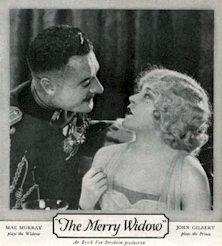
Three "silent" movies which I've had the good fortune to see on the big screen with live music: The Merry Widow, The Phantom of the Opera, and Safety Last.
 Hal Finney's Reusable Proofs of Work is important for at least two reasons: as a good stab at implementing bit gold, and for its use of the important idea of transparent servers: using remote attestation to verify the code running on servers.
The role of Stockholm syndrome in politics. Left as an exercise for the student. :-)
Three "silent" movies which I've had the good fortune to see on the big screen with live music: The Merry Widow, The Phantom of the Opera, and Safety Last.
Sunday, November 19, 2006
Underappreciated
Given that I subscribe to the law of the dominant paradigm, I have a soft spot in my heart for ideas that haven't gotten the attention they deserve. I try to choose such ideas to blog on. But I can't give all such ideas that I know of the necessary attention. Here are some:
Richard Dawkins himself is by now overexposed, but in his quest to convert the world to the atheist meme he, along with most of the rest of the world, has neglected his own theory of the extended phenotype. Like the metaphor of the selfish gene, this is an insight with many very important consequences. So far we've just scratched the tip of this iceberg.
Yoram Barzel is one of the most important economists of the last half century, but few people know this. Along with the much more famous Friedrich Hayek, Barzel is probably the economist who has influenced me the most. He has had a number of important insights related to transaction costs which I've confirmed repeatedly in my own observations and readings in economic history. Probably his most important insights relate to the importance and nature of value measurement. (“Measurement Cost and the Organization of Markets,” Journal of Law and Economics, April 1982 Reprinted in The Economic Foundations of Property Rights: Selected Readings, SPejovich, ed., Edward Elgar Publishing Company, 1997. And in Transaction costs and Property rights, Claude Menard, Editor, Edward Elgar publishing Company, 2004.) Another is his analysis of waiting in line (queuing) versus market prices as two methods of rationing. Waiting in line is the main means of rationing in a socialist economy but is surprisingly widespread even in our own. (“A Theory of Rationing by Waiting,” Journal of Law and Economics, April 1974 Reprinted in Readings in Microeconomics, Breit, Hochman, and Sauracker, 3rd ed., 1986).
Advanced cryptography over the last twenty-five years has come with a large number of important protocols. Public key encryption got all the hype, but it was just a warm-up. Alas, the perceived esoteric nature of the field and magical function of its protocols has apparently intimidated regular programmers away from implementing most of them. Appearances to the contrary they are based on solid math, not magic. I've blogged on some of these, but there is far more out there waiting to be picked up by mainstream computer security. Of all the advanced cryptography protocols secure time-stamping and multiparty secure computation are probably the most important.
The ideas of voluntary oblivious compliance and admonition systems from the capability security community. These are very useful in elucidating interelationships between wet protocols (e.g. manual procedures and law) and security. (By contrast I think capability security itself, and indeed the entire area of access control, is over-hyped: there are important roles for such things, for example in internal corporation access control, secure operating systems, and services where trust by all parties in corporate systems administrators is satisfactory, but they are nowhere close to being the be-all and end-all of distributed computing as often seems to be implied. Rather it's advanced cryptography where the most important advances in distributed security lie).
The whole topic of franchise jurisdiction, crucial to understanding medieval and Renaissance English law, has nevertheless long been almost completely neglected. It is also a very different paradigm of the power of courts that has been forgotten by the modern legal and political communities in favor of the Roman model of governmental sovereignty.
Almost any topic that requires knowledge from more than one academic specialty has been overly neglected: so much so that most such topics don't even exist but should.
The specific ideas mentioned are just the tip of the iceberg of underappreciated topics. Please let me know what ideas you think have been the most underappreciated. There are, I'm sure, many, many ideas out there that I should know about but don't.
Richard Dawkins himself is by now overexposed, but in his quest to convert the world to the atheist meme he, along with most of the rest of the world, has neglected his own theory of the extended phenotype. Like the metaphor of the selfish gene, this is an insight with many very important consequences. So far we've just scratched the tip of this iceberg.
Yoram Barzel is one of the most important economists of the last half century, but few people know this. Along with the much more famous Friedrich Hayek, Barzel is probably the economist who has influenced me the most. He has had a number of important insights related to transaction costs which I've confirmed repeatedly in my own observations and readings in economic history. Probably his most important insights relate to the importance and nature of value measurement. (“Measurement Cost and the Organization of Markets,” Journal of Law and Economics, April 1982 Reprinted in The Economic Foundations of Property Rights: Selected Readings, SPejovich, ed., Edward Elgar Publishing Company, 1997. And in Transaction costs and Property rights, Claude Menard, Editor, Edward Elgar publishing Company, 2004.) Another is his analysis of waiting in line (queuing) versus market prices as two methods of rationing. Waiting in line is the main means of rationing in a socialist economy but is surprisingly widespread even in our own. (“A Theory of Rationing by Waiting,” Journal of Law and Economics, April 1974 Reprinted in Readings in Microeconomics, Breit, Hochman, and Sauracker, 3rd ed., 1986).
Advanced cryptography over the last twenty-five years has come with a large number of important protocols. Public key encryption got all the hype, but it was just a warm-up. Alas, the perceived esoteric nature of the field and magical function of its protocols has apparently intimidated regular programmers away from implementing most of them. Appearances to the contrary they are based on solid math, not magic. I've blogged on some of these, but there is far more out there waiting to be picked up by mainstream computer security. Of all the advanced cryptography protocols secure time-stamping and multiparty secure computation are probably the most important.
The ideas of voluntary oblivious compliance and admonition systems from the capability security community. These are very useful in elucidating interelationships between wet protocols (e.g. manual procedures and law) and security. (By contrast I think capability security itself, and indeed the entire area of access control, is over-hyped: there are important roles for such things, for example in internal corporation access control, secure operating systems, and services where trust by all parties in corporate systems administrators is satisfactory, but they are nowhere close to being the be-all and end-all of distributed computing as often seems to be implied. Rather it's advanced cryptography where the most important advances in distributed security lie).
The whole topic of franchise jurisdiction, crucial to understanding medieval and Renaissance English law, has nevertheless long been almost completely neglected. It is also a very different paradigm of the power of courts that has been forgotten by the modern legal and political communities in favor of the Roman model of governmental sovereignty.
Almost any topic that requires knowledge from more than one academic specialty has been overly neglected: so much so that most such topics don't even exist but should.
The specific ideas mentioned are just the tip of the iceberg of underappreciated topics. Please let me know what ideas you think have been the most underappreciated. There are, I'm sure, many, many ideas out there that I should know about but don't.
Friday, November 10, 2006
Towards smarter democracy
Bryan Caplan has a great article on the irrationality of voters. (No, it's not a commentary on the most recent American election, which was probably a smidgen more rational than most, on balance). The basic idea, which I find unimpeachable except in one area, is that voters are almost never foreseeably impacted by their own votes. Single votes almost never change the outcome of elections. Even if they did they would rarely impact the voter or others in a way the voter clearly foresees. Given this disconnect between vote and consequence, votes instead are based on how good they make the voter feel. People vote in the first place, and then decide what to vote on, based almost entirely on their emotional needs rather than on a rational analysis of the kind that, for example, an engineer brings to designing software, an economist brings to crafting monetary policy, a lawyer brings to drafting a contract, a judge brings to interpreting law, or even that a boss or HR person brings to hiring a new employee.
I'd add that people use their political opinions to signal things they'd like their acquaintances to believe about their personality. For example, people support aid to the poor to signal to their friends and co-workers that they are generous people, and thus good people to be friends or co-workers with. The actual impact of any resulting policy on poor people or taxpayers or others generally remains unobserved by friends and co-workers and thus is irrelevant. Even if a friend believes the policy is mistaken, but that the opiner's heart is in the right place, this is sufficient for successful signaling. It's coming across as having a genuine desire to help the poor that counts. Similarly, people are motivated to vote in order to signal their altruistic participation in the community.
The one area Caplan fails to explore is very small-scale elections. I've long thought that juries, for example, are a much better example of democracy than large-scale elections. Jurors are forced to take the time to learn the facts (thus overcoming rational ignorance) and have a real case at hand (thus overcoming much of the mismatch between social signaling to ignorant friends and reality). They can clearly foresee the impact their verdict will have on the defendant. While Caplan extols the virtues of judges and other experts like himself (he'd like to have a Supreme Court of Economists to overturn bad economic legislation), such a Platonic oligarchy of experts needs to be checked and balanced by democracy. Juries, and the right of juries to judge law as well as fact (and for lawyers to argue law as well as fact in front of the jury), along with an unimpeachable right to trial by jury, are a much better way than large-scale elections to check oligarchy.
I'd add that people use their political opinions to signal things they'd like their acquaintances to believe about their personality. For example, people support aid to the poor to signal to their friends and co-workers that they are generous people, and thus good people to be friends or co-workers with. The actual impact of any resulting policy on poor people or taxpayers or others generally remains unobserved by friends and co-workers and thus is irrelevant. Even if a friend believes the policy is mistaken, but that the opiner's heart is in the right place, this is sufficient for successful signaling. It's coming across as having a genuine desire to help the poor that counts. Similarly, people are motivated to vote in order to signal their altruistic participation in the community.
The one area Caplan fails to explore is very small-scale elections. I've long thought that juries, for example, are a much better example of democracy than large-scale elections. Jurors are forced to take the time to learn the facts (thus overcoming rational ignorance) and have a real case at hand (thus overcoming much of the mismatch between social signaling to ignorant friends and reality). They can clearly foresee the impact their verdict will have on the defendant. While Caplan extols the virtues of judges and other experts like himself (he'd like to have a Supreme Court of Economists to overturn bad economic legislation), such a Platonic oligarchy of experts needs to be checked and balanced by democracy. Juries, and the right of juries to judge law as well as fact (and for lawyers to argue law as well as fact in front of the jury), along with an unimpeachable right to trial by jury, are a much better way than large-scale elections to check oligarchy.
Wednesday, November 08, 2006
A raw idea to avoid being cooked
I come up with far more ideas than I have time to properly evaluate, much less pursue. Long ago I worked at the Jet Propulsion Laboratory and I still occasionally daydream about space stuff. Recently there have been several proposals for shading the earth from the sun, put forth to combat global warming. I've been noodling on my own sunshade idea for several years. For your entertainment (and who knows, it might also turn out to be quite useful) here it is:
Put a bunch of Venetian blinds at a spot permanently between the earth and the sun (know to orbital engineers as the first earth-sun Lagrange point, a.k.a. "L1"). These blinds would be refractive rather than reflective to minimize the stationkeeping needed to prevent being "blown" away by the pressure of sunlight. At L1 they only need to refract the light by less than one degree of angle for the light to miss the earth. Less than 2% of sunlight needs to be deflected away from earth to offset the expected global warming from "greenhouse gases," primarily carbon dioxide.
Venetian blinds, unlike this proposal, and this one, can be opened or closed to allow continued control over the amount of sunlight hitting earth. This is essential since we can't really predict with great accuracy the degrees of global warming that we will need to combat. The blinds I propose, rather than being a number of joined slats as in a normal Venetian blind, are simply a large number of separate satellites each with a refractive slat that can be manuevered to any angle with the sun (i.e. from fully "closed" vertical to fully "open" horizontal).
I propose that the blinds be placed precisely at the region where they will deflect primarily light headed for equatorial regions on earth. That will even out temperatures a bit between northern and equatorial latitudes and reduce the energy (caused by temperature differences) available for storm formation, and thus probably the intensity of storms (although the effect, like the effect of global warming itself, on storms may be negligible). But the blinds should be maneuverable enough, by using solar electric propulsion or "sailing" on sunlight pressure, to redeploy to deflect sunlight headed to extreme latitudes if polar ice sheet melting becomes a larger problem than equatorial heat.
Instead of launching these vast (or vast number of) panels from the very deep gravity well of earth or manufacturing them on the moon (which probably lacks the proper organic ingredients and even sufficient water, a crucial industrial input), we can extract the raw materials from any near-earth asteroids containing water and methane ice or, if there are none such, from Jupiter-family comets. Besides the proper raw materials being available in sufficient volume in such ice, but probably not on the moon, there are a number of other advantages to microgravity ice mining explained in that linked article. If extracting material from comets and manufacturing the blinds can be automated the entire vast project can be conducted by launching just a few dozen of today's rockets using the recently-proven solar electric upper stages; otherwise it will require manned missions similar to those recently proposed to Mars, but again using solar-electric upper stages. (Solar electric rockets are only required for the first trip; much lower cost solar-thermal ice rockets can be used in subsequent trips, again as explained in that linked article).
Of course shades don't combat other effects of excess carbon dioxide such as ocean acidification and faster and differential plant growth, but these effects alone do not justify the vast costs of reducing carbon dioxide emissions. Indeed faster plant growth is probably a major economic benefit.
My off-the-cuff estimate of cost, which is probably as good as any recent NASA estimate for any of their gigaprojects, is that the project would cost $10 billion per year over 50 years. That's for the manned version; if it could be automated it would cost far less. This is far cheaper than other space-based sunshade proposals because once initial capital costs are made and the first two or three bootstrapping cycles have been undertaken, the ongoing transport costs of material from comet to the earth-sun L1 point are extremely small.
As a side benefit it would (unlike a mission to the moon or Mars or a "base" or any similar project) develop infrastructure needed for large-scale space industry and colonization. I propose funding the project, not with a tax, but by treating the blinds like a carbon dioxide sink and auctioning extra carbon dioxide credits for a global carbon dioxide market, since the shade allows us to be far less drastic in reducing growth of carbon dioxide emissions. If instead of a market we go with carbon taxes the project could be funded from those. $10 billion per year is much lower than even the most optimistic estimates (at 1% of world GDP about $500 billion per year) of the costs of reducing carbon dioxide emissions. Furthermore, there are a variety of other markets for large-scale industry that can be exploited once the basic ice mining infrastructure is developed: space tourism and making manned missions and other transportation around the solar system vastly less expensive, for starters, as well as providing propellant, tankage, and industrial raw materials in earth orbits. As I stated in 1994:
Put a bunch of Venetian blinds at a spot permanently between the earth and the sun (know to orbital engineers as the first earth-sun Lagrange point, a.k.a. "L1"). These blinds would be refractive rather than reflective to minimize the stationkeeping needed to prevent being "blown" away by the pressure of sunlight. At L1 they only need to refract the light by less than one degree of angle for the light to miss the earth. Less than 2% of sunlight needs to be deflected away from earth to offset the expected global warming from "greenhouse gases," primarily carbon dioxide.
Venetian blinds, unlike this proposal, and this one, can be opened or closed to allow continued control over the amount of sunlight hitting earth. This is essential since we can't really predict with great accuracy the degrees of global warming that we will need to combat. The blinds I propose, rather than being a number of joined slats as in a normal Venetian blind, are simply a large number of separate satellites each with a refractive slat that can be manuevered to any angle with the sun (i.e. from fully "closed" vertical to fully "open" horizontal).
I propose that the blinds be placed precisely at the region where they will deflect primarily light headed for equatorial regions on earth. That will even out temperatures a bit between northern and equatorial latitudes and reduce the energy (caused by temperature differences) available for storm formation, and thus probably the intensity of storms (although the effect, like the effect of global warming itself, on storms may be negligible). But the blinds should be maneuverable enough, by using solar electric propulsion or "sailing" on sunlight pressure, to redeploy to deflect sunlight headed to extreme latitudes if polar ice sheet melting becomes a larger problem than equatorial heat.
Instead of launching these vast (or vast number of) panels from the very deep gravity well of earth or manufacturing them on the moon (which probably lacks the proper organic ingredients and even sufficient water, a crucial industrial input), we can extract the raw materials from any near-earth asteroids containing water and methane ice or, if there are none such, from Jupiter-family comets. Besides the proper raw materials being available in sufficient volume in such ice, but probably not on the moon, there are a number of other advantages to microgravity ice mining explained in that linked article. If extracting material from comets and manufacturing the blinds can be automated the entire vast project can be conducted by launching just a few dozen of today's rockets using the recently-proven solar electric upper stages; otherwise it will require manned missions similar to those recently proposed to Mars, but again using solar-electric upper stages. (Solar electric rockets are only required for the first trip; much lower cost solar-thermal ice rockets can be used in subsequent trips, again as explained in that linked article).
Of course shades don't combat other effects of excess carbon dioxide such as ocean acidification and faster and differential plant growth, but these effects alone do not justify the vast costs of reducing carbon dioxide emissions. Indeed faster plant growth is probably a major economic benefit.
My off-the-cuff estimate of cost, which is probably as good as any recent NASA estimate for any of their gigaprojects, is that the project would cost $10 billion per year over 50 years. That's for the manned version; if it could be automated it would cost far less. This is far cheaper than other space-based sunshade proposals because once initial capital costs are made and the first two or three bootstrapping cycles have been undertaken, the ongoing transport costs of material from comet to the earth-sun L1 point are extremely small.
As a side benefit it would (unlike a mission to the moon or Mars or a "base" or any similar project) develop infrastructure needed for large-scale space industry and colonization. I propose funding the project, not with a tax, but by treating the blinds like a carbon dioxide sink and auctioning extra carbon dioxide credits for a global carbon dioxide market, since the shade allows us to be far less drastic in reducing growth of carbon dioxide emissions. If instead of a market we go with carbon taxes the project could be funded from those. $10 billion per year is much lower than even the most optimistic estimates (at 1% of world GDP about $500 billion per year) of the costs of reducing carbon dioxide emissions. Furthermore, there are a variety of other markets for large-scale industry that can be exploited once the basic ice mining infrastructure is developed: space tourism and making manned missions and other transportation around the solar system vastly less expensive, for starters, as well as providing propellant, tankage, and industrial raw materials in earth orbits. As I stated in 1994:
If the output of the icemaking equipment is high, even 10% of the original mass [returned to earth orbit by rockets using water propellant extracted from the comet ice] can be orders of magnitude cheaper than launching stuff from Earth. This allows bootstrapping: the cheap ice can be used to propel more equipment out to the comets, which can return more ice to Earth orbit, etc. Today the cost of propellant in Clarke [geosynchronous] orbit, the most important commercial orbit, is fifty thousand dollars per kilogram. The first native ice mission might reduce this to a hundred dollars, and to a few cents after two or three bootstrapping cycles.The savings for transporting materials to the earth-sun L1 point, instead of launching them from earth, are even larger.
Wednesday, November 01, 2006
Robot law
To what extent can law be mechanized? This author, Mark Miller, Lawrence Lessig, and others have proposed that software code can provide a substitute, to a greater or lesser degree, for various kinds of legal rules, especially in new software-driven areas such as the Internet. Indeed software increasingly provides a de facto set of law-like rules governing human interaction even when we don't intend such a result.
This post proposes a framework for mechanical laws in physical spaces inspired by the traditional English common law of trespass (roughly what today is called in common law countries the "intentional torts," especially trespass and battery).
Several decades ago, Isaac Asimov posited three laws to be programmed into robots:
Thus I propose to substitute for Asimov's Laws a framework which (1) is based on a real-world, highly evolved system of law that stressed concrete and objective rules rather than abstract, ambiguous, and subjective ethical precepts, (2) is "peer-to-peer" rather than "master-servant", and (3) is based, as much as possible, not on hypothetical human-like "artificial intelligence," but on a framework much of which can be tested with hardware and simple algorithms resembling those we possess today. Indeed, a prototype of this system can probably be developed using Lego(tm) robot kits, lasers, photosensors, sonar, video cameras, and other off-the-shelf hardware along with some custom computer programming using known algorithms.
Using such a prototype framework I hope that we can test out new legal rules and political systems in contests without harming actual humans. I also hope that we can test the extent to which law can be mechanized and to which security technology can prevent or provide strong evidence for breaches of law.
What about possible application to real-world security systems and human laws? In technical terms, I don't expect most of these mechanical laws to be applied in a robotic per se fashion to humans, but rather mostly to provide better notice and gather better evidence, perhaps in the clearest cases creating a prima facie case shifting the burden of lawsuit and/or the burden of proof to the person against whom clear evidence of law-breaking has been gathered. The system may also be used to prototype "smart treaties" governing weapons systems.
The main anthropomorphic assumption we will make is the idea that our robots can be motivated by incentives, e.g. by the threat of loss of property or of personal damage or destruction. If this seems unrealistic, think of our robots as being agents of humans who after initially creating the robots are off-stage. Under contest rules the humans have an incentive to program their robots to avoid damage to themselves as well as to avoid monetary penalties against their human owners; thus we can effectively treat the robots as being guided (within the limits of flexibility and forethought of simple algorithms) by such incentives.
The traditional trespasses are based on surfaces: a trespass on real property breaks a spatial boundary of that property, and a battery touches the skin or clothes or something closely attached to same (such as a tool grasped in the hand). Corresponding to such laws we have have developed a variety of security devices such as doors, locks, fences, etc. that provide notice of a surface and sometimes provide evidence that such a surface has been forceably crossed. The paradigmatic idea is "tres-pass", Law French for "big step": a crossing of a boundary that, given the notice and affordances provided, the trespasser knew or should have know was a violation of law. In our model, robots should have been programmed to not cross such boundaries without owner consent or other legal authority, ideas to be explored further below.
One way to set up this system is as contests between human programmers deploying their robots into the robot legal system. In a partially automated system there would be some human-refereed "police" and "courts," but an ideal fully-automated version would run without human intervention. Under contest rules in the fully-automated mode, after the human creators, who had an incentive to program the robots to respond to incentives, are done with their programming and the contest has commenced, only robots and other things exist in this robotic legal system. Only robots are legal persons; as such they can own other things and devices as well as spatial regions and things fixed therein (real property).
For each type of tort in my robot legal system, I propose a class of surface or other physical condition and correspondong class(es) of sensors:
(1) battery : physical surface of the robot (sensor detects touch). This touching must be the result of a physical trajectory that was probably not accidental (e.g. bumping a fellow robot on within a crowded space is probably not a battery).
(2) trespass to real property : three-dimensional surface of laser-break sensors bounding a space owned by a robot, or other location-finding sensors that can detect boundary crossings.
(3) trespass or conversion of moveable property: involves touch sensors for trespass to chattels; security against coversion probably also involves using RFID, GPS, or more generally proplets in the moveable property. But this is a harder problem, so call it TBD.
(4) assault is a credible threat of imminent battery : probably involves active and passive viewing devices such as radar, sonar and video and corresponding movement detection and pattern recognition. Specifics TBD (another harder problem).
Note that we have eliminated subjective elements such as "intent" and "harm." The idea is to replace these with deductiions from physical evidence that can be gathered by sensors. For example, evidence of a boundary crossing with force often in itself (per se) implies probable intent, and in such cases intent can be dispensed with as a conjunctive element or can be automatically inferred. With well-designed physical triggering conditions and notices and affordances to avoid them, we can avoid subjective elements that would require human judgment and still reach the right verdict in the vast majority of cases. In real world law such notices, affordances, and evidence-gathering would allow us to properly assign the burden of lawsuit to the prima facie lawbreaker so that a non-frivolous lawsuit would only occur in a miniscule fraction of cases. Thus security systems adapted to and even simulating real-world legal rules could greatly lower legal costs, but it is to be doubted that they could be entirely automated without at least some residual injustice.
Our robotic contract law is simply software code that the robots generated (or their human programmers have previously coded) and agree to abide by, i.e. smart contracts.
Three basic legal defenses (or justifications) for a surface break, taking of moveable property, or assault are:
(1) consent by the owner, expressed or implied (the former requires only some standard protocol that describes the surface and conditions for activity within that surface, i.e. a smart contract; I'm not sure what the latter category, implied consent, is in robot-land, but the "bumping in a crowded space" is probably an example of implied consent to a touch).
(2) self-defense (which may under certain circumstances include defense of property if the victim was illegally within a surface at the time), or
(3) other legal authorization.
The defense (3) of legal authorization is the most interesting and relates strongly to how robots are incentivized, i.e. punished and how robots are compensated for damages. In other words, what are the "police" and "courts" that enforce the law in this robotic world? Such a punishment is itself an illegal trespass unless it is legally authorized. The defense of legal authorization is also strongly related to the defense (2) of self-defense. That will be the topic, I hope, of a forthcoming post.
This post proposes a framework for mechanical laws in physical spaces inspired by the traditional English common law of trespass (roughly what today is called in common law countries the "intentional torts," especially trespass and battery).
Several decades ago, Isaac Asimov posited three laws to be programmed into robots:
I reject these as an approach for analyzing the mechanization of law because (i) they represent a law of robot servants towards human masters, which is quite different from my present goal of analyzing the mechanization of laws among equals (whether equal as fellow property or equal as fellow property owner), and (ii) they are hopelessly subjective and computationally intractible. How does a robot determine when a human has been "harmed"? Even if that problem was solved how does a robot predict when a human will come to harm, much less how to avoid their own actions causing such harm, much less what actions will lead to avoidance of that harm? While Asimov attempted to address some of these issues in various oversimplified scenarios in his stories, this is no substitute for the real-world experience of actual disputes and settlements, and the resulting precedents and the evolution of rules.1. A robot may not injure a human being, or, through inaction, allow a human being to come to harm.
2. A robot must obey orders given it by human beings, except where such orders would conflict with the First Law, and
3. A robot must protect its own existence as long as such protection does not conflict with the First or Second Law.
Thus I propose to substitute for Asimov's Laws a framework which (1) is based on a real-world, highly evolved system of law that stressed concrete and objective rules rather than abstract, ambiguous, and subjective ethical precepts, (2) is "peer-to-peer" rather than "master-servant", and (3) is based, as much as possible, not on hypothetical human-like "artificial intelligence," but on a framework much of which can be tested with hardware and simple algorithms resembling those we possess today. Indeed, a prototype of this system can probably be developed using Lego(tm) robot kits, lasers, photosensors, sonar, video cameras, and other off-the-shelf hardware along with some custom computer programming using known algorithms.
Using such a prototype framework I hope that we can test out new legal rules and political systems in contests without harming actual humans. I also hope that we can test the extent to which law can be mechanized and to which security technology can prevent or provide strong evidence for breaches of law.
What about possible application to real-world security systems and human laws? In technical terms, I don't expect most of these mechanical laws to be applied in a robotic per se fashion to humans, but rather mostly to provide better notice and gather better evidence, perhaps in the clearest cases creating a prima facie case shifting the burden of lawsuit and/or the burden of proof to the person against whom clear evidence of law-breaking has been gathered. The system may also be used to prototype "smart treaties" governing weapons systems.
The main anthropomorphic assumption we will make is the idea that our robots can be motivated by incentives, e.g. by the threat of loss of property or of personal damage or destruction. If this seems unrealistic, think of our robots as being agents of humans who after initially creating the robots are off-stage. Under contest rules the humans have an incentive to program their robots to avoid damage to themselves as well as to avoid monetary penalties against their human owners; thus we can effectively treat the robots as being guided (within the limits of flexibility and forethought of simple algorithms) by such incentives.
The traditional trespasses are based on surfaces: a trespass on real property breaks a spatial boundary of that property, and a battery touches the skin or clothes or something closely attached to same (such as a tool grasped in the hand). Corresponding to such laws we have have developed a variety of security devices such as doors, locks, fences, etc. that provide notice of a surface and sometimes provide evidence that such a surface has been forceably crossed. The paradigmatic idea is "tres-pass", Law French for "big step": a crossing of a boundary that, given the notice and affordances provided, the trespasser knew or should have know was a violation of law. In our model, robots should have been programmed to not cross such boundaries without owner consent or other legal authority, ideas to be explored further below.
One way to set up this system is as contests between human programmers deploying their robots into the robot legal system. In a partially automated system there would be some human-refereed "police" and "courts," but an ideal fully-automated version would run without human intervention. Under contest rules in the fully-automated mode, after the human creators, who had an incentive to program the robots to respond to incentives, are done with their programming and the contest has commenced, only robots and other things exist in this robotic legal system. Only robots are legal persons; as such they can own other things and devices as well as spatial regions and things fixed therein (real property).
For each type of tort in my robot legal system, I propose a class of surface or other physical condition and correspondong class(es) of sensors:
(1) battery : physical surface of the robot (sensor detects touch). This touching must be the result of a physical trajectory that was probably not accidental (e.g. bumping a fellow robot on within a crowded space is probably not a battery).
(2) trespass to real property : three-dimensional surface of laser-break sensors bounding a space owned by a robot, or other location-finding sensors that can detect boundary crossings.
(3) trespass or conversion of moveable property: involves touch sensors for trespass to chattels; security against coversion probably also involves using RFID, GPS, or more generally proplets in the moveable property. But this is a harder problem, so call it TBD.
(4) assault is a credible threat of imminent battery : probably involves active and passive viewing devices such as radar, sonar and video and corresponding movement detection and pattern recognition. Specifics TBD (another harder problem).
Note that we have eliminated subjective elements such as "intent" and "harm." The idea is to replace these with deductiions from physical evidence that can be gathered by sensors. For example, evidence of a boundary crossing with force often in itself (per se) implies probable intent, and in such cases intent can be dispensed with as a conjunctive element or can be automatically inferred. With well-designed physical triggering conditions and notices and affordances to avoid them, we can avoid subjective elements that would require human judgment and still reach the right verdict in the vast majority of cases. In real world law such notices, affordances, and evidence-gathering would allow us to properly assign the burden of lawsuit to the prima facie lawbreaker so that a non-frivolous lawsuit would only occur in a miniscule fraction of cases. Thus security systems adapted to and even simulating real-world legal rules could greatly lower legal costs, but it is to be doubted that they could be entirely automated without at least some residual injustice.
Our robotic contract law is simply software code that the robots generated (or their human programmers have previously coded) and agree to abide by, i.e. smart contracts.
Three basic legal defenses (or justifications) for a surface break, taking of moveable property, or assault are:
(1) consent by the owner, expressed or implied (the former requires only some standard protocol that describes the surface and conditions for activity within that surface, i.e. a smart contract; I'm not sure what the latter category, implied consent, is in robot-land, but the "bumping in a crowded space" is probably an example of implied consent to a touch).
(2) self-defense (which may under certain circumstances include defense of property if the victim was illegally within a surface at the time), or
(3) other legal authorization.
The defense (3) of legal authorization is the most interesting and relates strongly to how robots are incentivized, i.e. punished and how robots are compensated for damages. In other words, what are the "police" and "courts" that enforce the law in this robotic world? Such a punishment is itself an illegal trespass unless it is legally authorized. The defense of legal authorization is also strongly related to the defense (2) of self-defense. That will be the topic, I hope, of a forthcoming post.
Tuesday, October 24, 2006
Things as authorities
 When we hear the word "authority" we often think of people who have set themselves up in positions of power and on whom we have become dependent. But there is another kind of authority, often more reliable and trustworthy, that can be provided by things. These are physical standards, security devices, automata, and other objects by which we coordinate our interactions with fellow humans, especially with strangers who might not otherwise be trustworthy. These technologies are crucial to our modern civilization and its ability to make dealings with strangers more secure and reliable.
Authoritative automata often come in the form of what (on a computer) Mark Miller has dubbed an admonition system. An admonition system reminds a person of a plan or of a legal or ethical obligation. A clock, for example, can remind a person of a scheduled meeting, and a cash register communicates an obligation to pay.

With some extra security a device may also provide a strong affordance that requires the person to act purposefully to use it or to avoid using it, and may also gather evidence of such use or avoidance, as with tamper evidence. A locked door, for example, reminds a person about whether they have consent to enter, makes accidental entry effectively impossible, and often requires those who enter anyway to leave behind evidence of lock picking or forcible entry.
 Some technologies create standards that we all come to follow, as in standard weights and measures. Old unforgeably costly standards, such as those of shells used in hunter-gatherer and Neolithic cultures and the gold standard used up to modern times, enabled the emergence of money to replace barter and other costly and inconvenient in-kind transactions. Physical standards provide objective, verifiable, and repeatable interactions with our physical environment and with each other.
When new kinds of authoritative automata are proposed, the robotic response of Hello Kitty people is that they are inflexible and impersonal and thus not to be trusted. The Roman playwright Plautus made fun of early complainer of this kind, a bum objecting to one of the earliest authoritative devices, the sundial:

The gods confound the man who first found outBut history teaches that it is the many people who act strategically against strangers who are not to be trusted. It is human preferences, not machines, that are unpredictable and incomparable, as well they should be. For coordinating our interactions with strangers, impartial automata are often crucial.
How to distinguish the hours. Confound him too,
Who in this place set up a sundial,
To cut and hack my days so wretchedly
Into small pieces! When I was a boy,
My belly was my sundial -- only surer,
Truer, and more exact than any of them.
This dial told me when 'twas the proper time
To go to dinner, when I ought to eat;
But nowadays, why even when I have,
I can't fall to unless the sun gives leave.
The town's so full of these confounded dials!
 To what extent will computer algorithms come to serve as authorities? We've already seen one algorithm that has been in use for centuries: the adding algorithm in adding machines and cash registers. Some other authoritative algorithms have become crucial parts of the following:
(1) All the various protocols network applications use to talk to each other, such the web browser protocol you are probably using right now,
(2) The system that distributes domain names (the name of a web site found in an URL) and translate them to Internet protocol (IP) addresses -- albeit, not the ability to register domain names in the first place, which is still largely manual,

(3) Ranking algorithms such as Google page rank (for relevance based on a particular text search) and popularity ranking algorithms such as those used by Digg, Reddit, and the like,
(4) Payment systems, such as credit card processing and PayPal,
(5) Time distribution networks and protocols,
(6) The Global Positioning System (GPS) for determining location based on the time it takes radio signals to travel from a orbiting satellites, and
(7) A wide variety of other algorithms that many of us rely on to coordinate our activities.
Algorithms give us the potential of moving beyond the weak and reactive security of most physical devices to strong and often preventative security.
 Technologies such as digital signatures and mulitparty private computation may be used to implement things like unalterable audit trails, smart contracts, secure and owner-controlled property title registries, and so on. Bit gold, or property titles to unforgeably costly bits, might be possible. These automata will rely more on distribution and protocol security and less on trusted third parties than traditional authorities. There is a strong argument to be made that algorithmic authorities should be open source.
We've just scratched the surface of what secure authorities we can establish over computer networks. Such authorities will make it far easier for 6 billion plus strangers to interact with each other securely and reliably.
Monday, October 23, 2006
Fifty years ago today
 Today was the start of that glorious lost cause that ultimately won, the 1956 Hungarian Revolution. That event is today's featured article on Wikipedia. Since Hungary finally won its freedom from communist rule and Soviet control in 1989, October 23rd has been a national holiday.
Communism was an ideology based on envy of the rich but resulting in devastation to all. The keys to Soviet power were control over business, borders, and ideas. Control of the "commanding heights" of the economy and in particular control over food distribution made it highly dangerous to oppose communists rulers.
The Soviet bloc severely restricted exit, a policy known as the "iron curtain." A communist state was a vast prison camp: the government fed you and you were not allowed to leave. Except for a brief period during the 1956 Revolution, this state of affairs lasted until Hungary opened its borders to free Austria in 1989, leading later that year to the fall of the Berlin Wall and freedom in Eastern Europe.
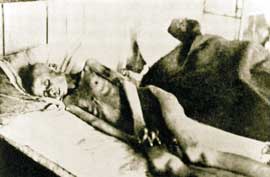 Victim of communist genocide in the Ukraine, 1930s.
The Soviets had a control over the observed reality and beliefs of its subjects that is hard to imagine in today's Internet era. The communist party owned all broadcast stations and newspapers and severely restricted smaller-scale means of communications such as telephones, small printing presses, and copy machines (and later faxes and computers). Government art encouraged secular worship of a godlike Marxist avant-garde, echoing the deification of emperors in imperial Rome.
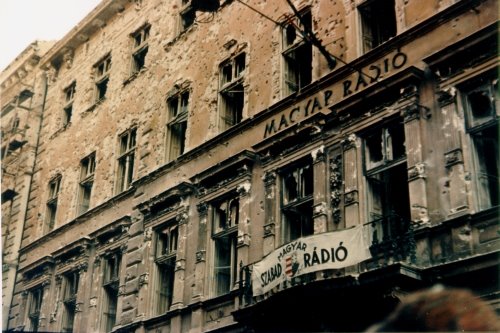 A crucial event in fighting totalitarianism: rebels took control of a radio station from the communist media monopoly and redubbed it "Magyar Szabad Radio" (Hungarian Free Radio)
Thus, although the Soviets had already murdered millions, directly and through robbery of food and other vital supplies (as in "Ukranian famines" under both Lenin and Stalin), little was known about these events: behind the iron curtain all mention of them was excised from academia and media; outside the iron curtain they were unknown, denied, or ignored. To this day these events, collectively the greatest mass murders in world history committed by any ideological movement within a single century, remain largely forgotten thanks to the remarkably successful efforts of Soviets in destroying or simply failing to report publicly the evidence.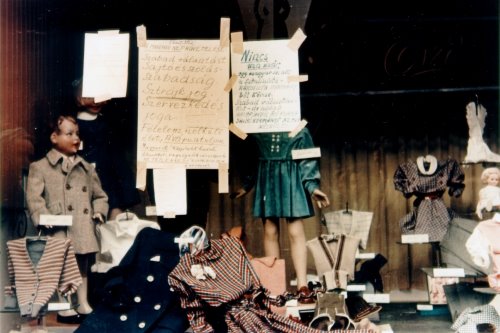 Meatspace blog: messages for rebels in shop window.
The resignation of the Stalin-era dictator Mátyás Rákosi under pressure from the new Soviet dictator Kruschev in July of 1956 emboldened Hungarians to speak somewhat more freely among themselves. László Rajk, judicially murdered under the Rákosi regime, was reburied and celebrated and the anti-Stalinist Imre Nagy (pronounced "Nahj") was invited to rejoin the Hungarian Worker's Party (the communist party and the only legal party). On October 16th students in University of Szeged boycotted the official party student union and reestablished the non-communist MEFESZ student union which had been banned under Rákosi. Soon students all over Hungary followed suit.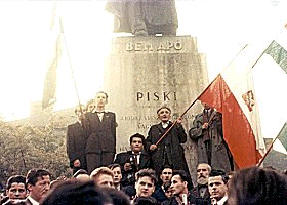 Students demonstrating.
Members of the Hungarian Writer's Union and students, numbering over ten thousand, gathered to demand reform on October 23rd -- 50 years ago today -- at the statute of General Bem, a hero of Hungary's War of Independence in 1849. Students who had brought some Hungarian flags started cutting out the hated communist red star from the flags, leaving ragged circles. By 6 p.m., the crowd had crossed the Danube to the Parliament Building. Enthusiastic locals swelled it to probably well over a hundred thousand. Some enthusiasts toppled the largest Stalin statue, leaving his boots. Stalin's boots.
The government radio stations, the only ones allowed, railed that the crowds were "reactionary mobs." ("Reactionary" was the favorite insult of self-styled "progressives" in both the Soviet bloc and the West.) In response a crowd gathered at Radio Budapest, guared by the State Protection Authority (Államvédelmi Hatóság or ÁVH), the communist Hungarian equivalent of the U.S. FBI. When some of the crowd's leaders expressed demands for equal time on the radio to rebut the government's slanders, the ÁVH detained them and the crowd grew even angrier. Soon the ÁVH fired tear gas into the crowd, and soon after that started shooting into the crowd. Hungarian soldiers (of the regular army) were sent in to assist the ÁVH, but when some soldiers witnessed the protestors being fired on they mutinied, joining the crowd. The crowd and its new army recruits fanned out, siezing control of military depots and distributing guns. The Revolution had begun.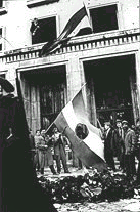 Rebels overan the communist party's headquarters and cut out the hated red star from the Hungarian flag.
 Ghandian non-violent resistance only works where there is a well-established free press sympathetic to the resisters. This was certainly not the case behind the iron curtain in 1956. After the ÁVH fired on unarmed protestors most of the Hungarian Army sided with the protestors, defended them from the ÁVH, and helped them capture the government radio station. With control of the radio station rebels were able to broadcast their rebuttals of the government's slanders, to call for justice against the murderers of protestors, and to make their case for anti-communist reforms. Military depots were raided and arms distributed to civilian rebels, defeating communist gun control.
Sunday, October 22, 2006
The pigeonhole principle
 The pigeonhole principle sounds trivial but is profound. It says that you can't fit n pigeons into fewer than n holes without cramming at least two pigeons into one of the holes. It says that somebody must lose in a game of musical chairs. In fancier mathematese, which you can safely skip if it sounds like gibberish, the pigeonhole principle says that there is no bijective (or 1-to-1 and onto) mapping (or function) between a set S and any proper subset of S, or for that matter any set smaller than S. [*]
The pigeonhole principle readily proves that there are people in Ohio with the same number of hairs on their head, that you can't eliminate the possibility of hash collisions when the set of possible input data is larger than the possible outputs, that if there are at least two people in a room then there must be at least two people in that room with the same number of cousins in the room, and that a lossless data compression algorithm must always make some files longer. This is just the tip of the iceberg of what the pigeonhole principle can help prove.
First let's prove that if there are n people in the room, where n is at least two, then there must be at least two (but not necessarily n) people in that room with the same number of cousins (of the same degree or less) in the room. In mathematese (which you can again ignore if you wish) being a "cousin" a symmetric relationship (if I'm your cousin then you're mine) and non-reflexive (I'm not my own cousin). The proof actually works for any such relationship: twins separated at birth, members of the opposite sex, and so on. Here it is, another proof by contradiction:

(1) Assume that each person in the room has a different number of cousins in the room;
(2) Putting the pigeons in their holes, one person must have no cousins, and another one cousin, and so on; the nth person must have n-1 cousins. That fills up all the holes with no doubly-stuffed holes, right?
(3) Yes, but if the nth person is a cousin with every other person in the room, then there can be nobody in the room with no cousins, so sequence (2) is an impossible contradiction, proving that in fact statement (1) is false: there must be at least two pigeons in the same hole, i.e. at least two people with the same number of cousins in the room.
Next let's prove (again by contradiction) that any lossless compression algorithm must make some file larger:
(1) Since it's a compression algorithm, by definition at least one file will be made shorter. Call the shortest such file F of size m which compresses to size n (i.e. n<m);
(2) furthermore assume no file will be made longer;
(3) thus every file of size n or less is incompressible;
(4) since no files are made longer, thus there must be at least 2^n + 1 files that compress to size n or less: all files of size n or less plus file F;
(5) but we can't fit 2^n + 1 pigeons into 2^n holes without putting two pigeons in one of the holes: in other words, at least two files must compress to the same output file, which is lossy compression;
(6) thus assumption (2) is false: if the compression is lossless some file must be made longer.
Lossless compression nevertheless can be quite effective because data is usually far from uniformly distributed among the 2^n possibilities. The most common patterns are given the shortest codes, resulting in overall compression in almost all real files that aren't already compressed, encrypted, or otherwise random.
The proofs on hairs and hash collisions are left as exercises for the student. (Don't you hate when math textbooks say that?)

An old pigeon farm, back when people actually ate these nasty critters. Presumably all the pigeons fit into all the holes.
[*] Update: this holds for finite sets; the technicalities are a bit different for infinite sets. See comments.
Friday, October 20, 2006
Three kinds of jurisdiction
Jurisdiction is the legal right of a court to order coercive process: to imprison a person, to put them on trial, to punish criminals, and to require plaintiffs with a variety of remedies (ranging from payment of damages to injunctions) at the expense of defendants. Subject matter jurisdiction is the areas of law over which a court may legally assert jurisdiction, and personal jurisdiction is those persons over which a court may assert jurisdiction.
The question of which court has jurisdiction is in theory independent of the question of which law will be applied ("choice of law" or "conflict of laws"), though they for various practical reasons they are often in fact intertwined.
Jurisdiction comes in three basic forms:
(1) Sovereign government. This is what we were taught in high school civics class -- courts have jurisdiction over us because -- well, because they're "the government," that's why. Many people now consider this the only kind of jurisdiction. However, historically sovereign jurisdiction had its origin in a much more general kind of jurisdiction:
(2) Property. One owns jurisdiction over certain subject matters, and exercises that jurisdiction over certain tenants or visitors to one's franchise territory, based on conditions in the property deed or covenant. Often the franchise territory is simply the territory of the land one owns and to which the franchise is attached, but the charter defining the franchise could specify a different territory. The largest jurisdiction is the realm itself, the jurisdiction owned by the king, and consisting of all jurisdiction in the realm not owned by others in the form of a granted or prescriptive franchise. Jurisdiction as property was historically often associated with feudal or colonial government, but the degree of decentralization possible varied radically. In its more decentralized forms (such as those of medieval Iceland, and to a lesser extent medieval and Renaissance England) this is a radically different model of jurisdiction than that based on sovereign government. More here.
(3) Contract. This has been common in various times and places, and is on the rise in many parts of the modern world in the form of choice of law and choice of forum clauses (often called "arbitration clauses" because they often specify a private arbitrator instead of a state court). Contractual jurisdiction works much better for relational disputes than for torts between strangers. Conceivably, however, a network of contracts in which people agree to delegate consent to jurisdiction could grow dense enough to cover most or even all persons who might contact each other. There are however no modern examples of this. Medieval Iceland has sometimes been interpreted as an example of universal contract-based jurisdiction, but is better viewed as a hybrid property/contract system, since it was based on a franchise-like property right called a "godord."
The U.S. Supreme Court splits on its justifications for why a state may exercise of broad jurisdiction. The view of conservative justices is just that states are sovereign over their territories, period. If the state "tags" you inside its territory you are "it" in their courts for any amount of liability, even if you were just passing through. Liberal justices have justified state jurisdiction as a kind of restitution or implied contract, described further below. Under both views you can also be hauled in from outside the state if you had "minimal contacts" with that state, for example shipping a product there.
Thoughtful political and legal scholars have long recognized that jurisdiction requires much more than brute force assertion: it requires some kind of consent of the governed. Legal scholar Lysander Spooner long ago debunked the idea that government is a "social contract" that you and I actually agreed to abide by. Neither you nor I have ever agreed to any such thing by any process resembling that of formation in contract law. The liberal justices dredge up a similar argument: by entering a state territory and performing some minimal act, such as driving on the roads, you have "availed" yourself of the protections of that jurisdiction. By driving on the road, for example, you have availed yourself of the "significant benefit" of police services, and thereby have now subjected yourself to the full sovereign jurisdiction of that state -- even if that puts you in jeopardy of a penalty far out of proportion to any benefit you have obtained, and even if the penalty is for something completely unrelated to the benefit.
For example, let's say you were married and living in New Jersey and your spouse ran off to California with the kids. You visit California for three days to see the children.
Both the liberals and conservative justices in the U.S. agree that your spouse can greatly extend your stay by hauling you into California court to dissolve your New Jersey marriage and split up your New Jersey property. But they agree on this grotesque idea for different reasons.
According to the conservatives, California is sovereign and can simply can tag you because you are in their territory. According to the liberal justices, you have "availed" yourself of the "significant benefits" of the California laws by driving on California roads, and thereby justified California gaining control over your marriage, your children, and your property. (The actual case was Burnham v. Superior Court of California, 495 U.S. 604 (1990)).
One cannot rebut the conservatives because they just make a raw assertion: a conclusory statement, not an argument. Your spouse simply needs to file a complaint and serve you with process in California territory: tag and you're it. Stay away from your spouse and kids and your New Jersey marriage and New Jersey property are safe from the tender mercies of the California courts. Take one step inside and it's all up for grabs.

The shallowness of the liberals' pseudo-contractual argument can be seen by translating it to an actual contractual setting. Suppose you stepped onto a car lot called Mike's Maserati Mecca and were talked into test driving that slick silver bullet you certainly can't afford. After a thoroughly enjoyable ride with Mike, in which you consented to follow his directions and availed yourself of the significant benefits of his hospitality, Mike presented you with a contract from the back office. He then declared that, by driving the car, you thereby agreed to buy it. The price is the standard market price, but that doesn't mean that you can afford it. Call it a "drive-wrap contract."
No court anywhere I know of would enforce this "contract": your small act of stepping into the car dealer's territory, availing yourself of property protected by Mike's security guard, and even the somewhat larger and related act of test-driving his car, in no way could be construed as consent to "rules of the territory" that include an obligation to purchase the car. Many courts have a derogatory name for this: "officious intermeddling." Another example: if the neighbor kid shows up one day and simply starts mowing your lawn, there is no implied contract whereby you owe the kid the typical price of a mown law. You may be morally or reputationally obligated in your neighborhood, depending on its norms, but it is not a legal obligation. The only vaguely analogous situation where a court will allow a person to force a contract with you is if you are completely incapacitated and desperately in need a help: if a doctor helps you, a typical court will construe the existence of a contract to pay the doctor a reasonable fee, because that is what you almost surely would have agreed to had you been conscious. This implied-in-law contract is also often called an action for "restitution": you have been unfairly enriched by the doctor, and must "disgorge" the unfair enrichment.
On the other hand, if you had started smashing on of Mike's Maseratis with a sledge hammer, Mike would under traditional common law be within his rights to restrain and arrest you for vandalism on his property. See also Semayne's Case for the implied franchise that pertains to one's house to protect it from trespass. While (in the same move away from traditional English law that gave us the doctrine of substantive sovereign jurisdiction in place of property-based jurisdiction) many jurisdictions have restricted rights to defend oneself and one's property, many other jurisdictions retain them in statute, such as the "stand your ground" statutes that give you the right to protect your property as well as yourself in your house, and in some state in your automobile and at your place of business. Similarly, if while in California you started beating your spouse, there would be no traditional common law objections to California dealing with you in defense of its resident. Committing a tort (or crime) is itself implied consent to tort (or criminal) jurisdiction.
The liberal justices with their pseudo-contractual or pseudo-restitutionary talk of "availment" to "significant benefit" giving rise to arbitrary jurisdiction do not explain why California's assertion of jurisdiction over out-of-state marriage and property is not also simply officious intermeddling. They certainly do not explain why, even if you've unfairly enriched yourself by driving free on California's roads, you should be forced to disgorge far more than the value you obtained, and in areas of your life unrelated to highway safety: your marriage, property, and children.
Assertion of sovereign jurisdiction, the kind were taught in school is the only kind, is in fact the kind of jurisdiction that is the most unjust and that is on most intellectually shaky ground. U.S. courts either simply don't try to justify it or try to justify it with absurd pseudo-contractual arguments. Like their intellectual forebears with their specious idea of a "social contract," many modern justices at least recognize the moral requirement for consent to jurisdiction. But they too fail to address the issue with intellectual seriousness, because the consequences for the law of jurisdiction would be too radical: their own courts could lose most of their power.
There are some good arguments for some sovereign jurisdiction, but they lead to a sovereignty far smaller than that exercised by the modern state. The necessity for some minimal sovereign court, to which you and I are bound "just because," seems unavoidable. For both the property- and contract-based jurisdictions there seems to be the need for at least a "night watchman" or "meta" court that determines the questions of basic jurisdiction itself. In property-based jurisdictions such as the franchises of England, the king's courts determined these questions as a matter of "trespass" on (infringement of) franchise property. It was also possible for a court to trespass on a defendant by violating basic due process rights associated with the type of jurisdiction, for example torturing the defendant or by denying right to a trial by jury. In a contract-based system, involuntary courts with large territories would be needed to determine, if disputed, the preliminary question of whether a proper contract had been formed with a proper choice of forum clause. In the U.S. this question is answered by the court with jurisdiction over the contract, usually a court of the state where the contract was formed.
The question of which court has jurisdiction is in theory independent of the question of which law will be applied ("choice of law" or "conflict of laws"), though they for various practical reasons they are often in fact intertwined.
Jurisdiction comes in three basic forms:
(1) Sovereign government. This is what we were taught in high school civics class -- courts have jurisdiction over us because -- well, because they're "the government," that's why. Many people now consider this the only kind of jurisdiction. However, historically sovereign jurisdiction had its origin in a much more general kind of jurisdiction:
(2) Property. One owns jurisdiction over certain subject matters, and exercises that jurisdiction over certain tenants or visitors to one's franchise territory, based on conditions in the property deed or covenant. Often the franchise territory is simply the territory of the land one owns and to which the franchise is attached, but the charter defining the franchise could specify a different territory. The largest jurisdiction is the realm itself, the jurisdiction owned by the king, and consisting of all jurisdiction in the realm not owned by others in the form of a granted or prescriptive franchise. Jurisdiction as property was historically often associated with feudal or colonial government, but the degree of decentralization possible varied radically. In its more decentralized forms (such as those of medieval Iceland, and to a lesser extent medieval and Renaissance England) this is a radically different model of jurisdiction than that based on sovereign government. More here.
(3) Contract. This has been common in various times and places, and is on the rise in many parts of the modern world in the form of choice of law and choice of forum clauses (often called "arbitration clauses" because they often specify a private arbitrator instead of a state court). Contractual jurisdiction works much better for relational disputes than for torts between strangers. Conceivably, however, a network of contracts in which people agree to delegate consent to jurisdiction could grow dense enough to cover most or even all persons who might contact each other. There are however no modern examples of this. Medieval Iceland has sometimes been interpreted as an example of universal contract-based jurisdiction, but is better viewed as a hybrid property/contract system, since it was based on a franchise-like property right called a "godord."
The U.S. Supreme Court splits on its justifications for why a state may exercise of broad jurisdiction. The view of conservative justices is just that states are sovereign over their territories, period. If the state "tags" you inside its territory you are "it" in their courts for any amount of liability, even if you were just passing through. Liberal justices have justified state jurisdiction as a kind of restitution or implied contract, described further below. Under both views you can also be hauled in from outside the state if you had "minimal contacts" with that state, for example shipping a product there.
Thoughtful political and legal scholars have long recognized that jurisdiction requires much more than brute force assertion: it requires some kind of consent of the governed. Legal scholar Lysander Spooner long ago debunked the idea that government is a "social contract" that you and I actually agreed to abide by. Neither you nor I have ever agreed to any such thing by any process resembling that of formation in contract law. The liberal justices dredge up a similar argument: by entering a state territory and performing some minimal act, such as driving on the roads, you have "availed" yourself of the protections of that jurisdiction. By driving on the road, for example, you have availed yourself of the "significant benefit" of police services, and thereby have now subjected yourself to the full sovereign jurisdiction of that state -- even if that puts you in jeopardy of a penalty far out of proportion to any benefit you have obtained, and even if the penalty is for something completely unrelated to the benefit.
For example, let's say you were married and living in New Jersey and your spouse ran off to California with the kids. You visit California for three days to see the children.
Both the liberals and conservative justices in the U.S. agree that your spouse can greatly extend your stay by hauling you into California court to dissolve your New Jersey marriage and split up your New Jersey property. But they agree on this grotesque idea for different reasons.
According to the conservatives, California is sovereign and can simply can tag you because you are in their territory. According to the liberal justices, you have "availed" yourself of the "significant benefits" of the California laws by driving on California roads, and thereby justified California gaining control over your marriage, your children, and your property. (The actual case was Burnham v. Superior Court of California, 495 U.S. 604 (1990)).
One cannot rebut the conservatives because they just make a raw assertion: a conclusory statement, not an argument. Your spouse simply needs to file a complaint and serve you with process in California territory: tag and you're it. Stay away from your spouse and kids and your New Jersey marriage and New Jersey property are safe from the tender mercies of the California courts. Take one step inside and it's all up for grabs.

The shallowness of the liberals' pseudo-contractual argument can be seen by translating it to an actual contractual setting. Suppose you stepped onto a car lot called Mike's Maserati Mecca and were talked into test driving that slick silver bullet you certainly can't afford. After a thoroughly enjoyable ride with Mike, in which you consented to follow his directions and availed yourself of the significant benefits of his hospitality, Mike presented you with a contract from the back office. He then declared that, by driving the car, you thereby agreed to buy it. The price is the standard market price, but that doesn't mean that you can afford it. Call it a "drive-wrap contract."
No court anywhere I know of would enforce this "contract": your small act of stepping into the car dealer's territory, availing yourself of property protected by Mike's security guard, and even the somewhat larger and related act of test-driving his car, in no way could be construed as consent to "rules of the territory" that include an obligation to purchase the car. Many courts have a derogatory name for this: "officious intermeddling." Another example: if the neighbor kid shows up one day and simply starts mowing your lawn, there is no implied contract whereby you owe the kid the typical price of a mown law. You may be morally or reputationally obligated in your neighborhood, depending on its norms, but it is not a legal obligation. The only vaguely analogous situation where a court will allow a person to force a contract with you is if you are completely incapacitated and desperately in need a help: if a doctor helps you, a typical court will construe the existence of a contract to pay the doctor a reasonable fee, because that is what you almost surely would have agreed to had you been conscious. This implied-in-law contract is also often called an action for "restitution": you have been unfairly enriched by the doctor, and must "disgorge" the unfair enrichment.
On the other hand, if you had started smashing on of Mike's Maseratis with a sledge hammer, Mike would under traditional common law be within his rights to restrain and arrest you for vandalism on his property. See also Semayne's Case for the implied franchise that pertains to one's house to protect it from trespass. While (in the same move away from traditional English law that gave us the doctrine of substantive sovereign jurisdiction in place of property-based jurisdiction) many jurisdictions have restricted rights to defend oneself and one's property, many other jurisdictions retain them in statute, such as the "stand your ground" statutes that give you the right to protect your property as well as yourself in your house, and in some state in your automobile and at your place of business. Similarly, if while in California you started beating your spouse, there would be no traditional common law objections to California dealing with you in defense of its resident. Committing a tort (or crime) is itself implied consent to tort (or criminal) jurisdiction.
The liberal justices with their pseudo-contractual or pseudo-restitutionary talk of "availment" to "significant benefit" giving rise to arbitrary jurisdiction do not explain why California's assertion of jurisdiction over out-of-state marriage and property is not also simply officious intermeddling. They certainly do not explain why, even if you've unfairly enriched yourself by driving free on California's roads, you should be forced to disgorge far more than the value you obtained, and in areas of your life unrelated to highway safety: your marriage, property, and children.
Assertion of sovereign jurisdiction, the kind were taught in school is the only kind, is in fact the kind of jurisdiction that is the most unjust and that is on most intellectually shaky ground. U.S. courts either simply don't try to justify it or try to justify it with absurd pseudo-contractual arguments. Like their intellectual forebears with their specious idea of a "social contract," many modern justices at least recognize the moral requirement for consent to jurisdiction. But they too fail to address the issue with intellectual seriousness, because the consequences for the law of jurisdiction would be too radical: their own courts could lose most of their power.
There are some good arguments for some sovereign jurisdiction, but they lead to a sovereignty far smaller than that exercised by the modern state. The necessity for some minimal sovereign court, to which you and I are bound "just because," seems unavoidable. For both the property- and contract-based jurisdictions there seems to be the need for at least a "night watchman" or "meta" court that determines the questions of basic jurisdiction itself. In property-based jurisdictions such as the franchises of England, the king's courts determined these questions as a matter of "trespass" on (infringement of) franchise property. It was also possible for a court to trespass on a defendant by violating basic due process rights associated with the type of jurisdiction, for example torturing the defendant or by denying right to a trial by jury. In a contract-based system, involuntary courts with large territories would be needed to determine, if disputed, the preliminary question of whether a proper contract had been formed with a proper choice of forum clause. In the U.S. this question is answered by the court with jurisdiction over the contract, usually a court of the state where the contract was formed.
Subscribe to:
Posts (Atom)