In his novel Cat’s Cradle, science fiction writer Kurt Vonnegut postulated “Ice-9.” Ice-9 was a form of water that was frozen at room temperature and catalyzed any normal water it came in contact with into more crystals of Ice-9. Once released into the environment, it froze all water, including us. Eric Drexler in the 1980s raised the specter of nano-robots that made copies of themselves and ate everything in their path: "gray goo." A wide variety of similar hypothetical disasters have since been given referred to as some sort of "goo."
Self-replicating chemicals are not merely hypothetical: since Cat's Cradle, scientists have discovered some real-world example of crystals that seed the environment, converting other forms (polymorphs) of the crystal into their own. The population of the original polymorph diminishes as it is converted into the new form: it is a “disappearing polymorph.” In 1996 Abbott Labs began manufacturing the new anti-AIDS drug ritonavir. In 1998 a more stable polymorph appeared in the American manufacturing plant. It converted the old form of the drug into a new polymorph, Form 2, that did not fight AIDS nearly as well. Abbott’s plant was contaminated, and it could no longer manufacture effective rintonavir. Abbott continued to successfully manufacture the drug in its Italian plant. Then American scientists visited, and that plant too was contaminated was contaminated and could henceforth only produce the ineffective Form 2. Apparently the scientists had carried some Form 2 crystals into the plant on their clothing.
Another instance of the “disappearing polymorph” may be the anti-depressant, Paxil (U.S. brand name for the chemical paroxetine hydrochloride). No, self-replicating Paxil doesn’t naturally spread into our brains and make people happy for free. It's not "happy goo." On the contrary, self-replicating Paxil converted, according to one of the parties in the ensuing lawsuit, an old, and now off-patent, form of Paxil into a new, patented form of Paxil. Once the new form, the hemihydrate form of Paxil, was created, its crystals started floating about, converting small fractions of the old form, anhydrous Paxil, into hemihydrate. Both forms of the drug work equally well as an anti-depressant, but it became impossible to manufacture the off-patent anhydrate without some of it being converted into the patented form. Call it "patent goo."
Apotex, a generic drug manufacturer, was all set up to manufacture the off-patent anhydrous generic Paxil when it discovered small fractions of it were being converted into the hemihydrate. They couldn’t remove the contamination. Smithkline, owner of the patent on the hemihydrate, sued them for patent infringement. Apotex argued that the hemihydrate form occurred naturally, so that Smithkline’s patent was invalid. Smithkline argued that it was a disappearing polymorph, that the hemihydrate form had not existed before they had created it in their labs, and that it was up to Apotex to remove the hemihydrate from its product or pay it a royalty. Apotex was unable to remove the hemihydrate and unwilling to pay a royalty.
Judge Richard Posner heard this case in the trial court and wrote an opinion that contains a good explanation of the self-replicating Paxil controversy. The Federal Circuit heard the appeal and decided that Smithkline’s patent on the hemihydrate was invalid as “inherently anticipated” because anhydrate naturally converts into hemihydrate. Normally, anticipation would require an actual reference describing the claimed chemical structure (in patent lingo that the hemihydrate was "taught in the prior art"). But Judge Rader held that inherent anticipation occurs when, more likely than not, an operation that is taught in the prior art would result in the claimed chemical. The anhydrate which was taught in the prior art would more than likely result in natural creation of some hemihydrate. Judge Gajarsa in concurrence argued that the drug was discovered not invented, making it unpatentable subject matter. Gajarsa’s opinion may have inspired the United States Supreme Court to raise the subject matter issue on its own (i.e., it had not been argued by the parties to the case) in Metabolite. The Supreme Court is considering whether to take the appeal on the self-replicating Paxil case as well.
Monday, September 22, 2008


The kula ring
 Just off the cost of New Guinea, Melanesians evolved (over thousands, and perhaps even tens of thousands, of years) a unique commercial institution known as the "kula ring" for the collectibles that circulated within it.
The unforgeably scarce kula collectibles doubled as "high power" money and mnemonic for stories and gossip. Many of the goods traded, mostly agricultural products, were available in different seasons, and so could not be traded in kind. Kula collectibles solved this double-coincidence problem as an unforgeabaly costly, wearable (for security), and circulated (literally!) money. Necklaces circulated clockwise, and armshells counter-clockwise, in a very regular pattern. By solving the double-coincidence problem an armshell or necklace would prove more valuable than its cost after only a few trades, but could circulate for decades. Gossip and stories that about prior owners of the collectibles further provided information about upstream credit and liquidity. In other Neolithic cultures collectibles, usually shells, circulated in a less regular pattern but had similar purposes and attributes.

Sunday, September 07, 2008
A letter from the industrial revolution

Images: Copper halfpenny minted by the Darbies' Coalbrookdale Company and celebrating the Iron Bridge.
Here's an interesting letter from the dawn of the industrial revolution. It was written in 1775 by Abiah Darby, mother of Abraham Darby (III) and wife of Abraham Darby (II), the son of Abraham Darby (I), who invented the process of smelting iron with coke made from coal. The Darby family were Quakers and produced several early industrialists and engineers. This small letter makes or implies several points that may have been crucial to the growth of industry that makes modern wealth possible:
* The importance of property rights and market prices in maintaining a sustainable balance between the supply and demand of wood. ("woods for charcoal became very Scarce and landed Gentlemen rose the prices of cord wood exceeding high"). Although wood became expensive, there remained a sufficient supply of wood for the buildings, mine works, wagons, rails, etc.
* The ability of people living with sufficient technology and secure property rights to bypass and surpass ecological limitations (in this case substituting coal for wood, and later due to this cheap iron-making process, iron and steel for wood).
* Decentralized money issue. Abiah points out that the remote area of Coalbrookdale, where coal and iron were available, still often operated as a barter economy. Thus apparently Abraham had to either coin tokens or open a bank to issue notes (common during this era) so that the Darbies could pay their workers.
* Darby II's invention of the iron-tracked railroad (improving the productivity of the horses by over six times and precursor to the later steam-powered railroad).
* The ability to securely establish large machine works and lay 20 miles of track out in the boondocks and not have them be torn up by trespassers and used for other purposes or confiscated or taxed into oblivion by local lords. In most of the rest of the world that could not be taken for granted.
* The use of atmospheric pressure (Papin/Savery/Newcomen) steam engines to drain the mines and supply water to the waterwheel pond. (The atmospheric engine apparently wasn't up to the job of directly powering the bellows for the blast furnaces; that came later with the Watt steam pressure engine). Steam engines allowed water to be pumped out of mines at a far greater rate, and thus allowed coal and iron mines to be dug far deeper, creating a large and inexpensive new supply of coal and iron.
The link is a Word document, which I don't recommend opening for security reasons, but I've copied the contents below:
http://www.umassd.edu/ir/Resources/MetalandMining/m2.doc
Mrs. Abiah Darby on developments in the Darby ironworks at Coalbrookdale, 1708-1763
Esteemed Friend,
Thy very acceptable favour of the 9th ulto. claim'd my earliest acknowledgments, which I should immediately have made, had not thy kind condescension in taking notice of my late honour'd Husband, and requesting to be inform'd of any circumstance which may be interesting relating him, caused my delay-to recollect what might occur concerning his transactions or improvements in the Manufactory of Iron, so beneficial to this nation. But before I proceed further, I cannot help lamenting with thee in thy just observation, " that it has been universally observed, that the Destroyers of mankind are recorded and remembered, while the Benefactors are unnoticed and forgotten". This seems owing to the depravity of the mind, which centres in reaping the present advantages, and suffering obscurity to vail the original causes of such benefits; and even the very names of those to whom we are indebted for the important discoveries, to sink into oblivion. Whereas if they were handed down to posterity, gratitude would naturally arise in the commemoration of their ingenuity, and the great advantages injoyed from their indefatigable labours-I now make free to communicate what I have heard my Husband say, and what arises from my own knowledge; also what I am inform'd from a person now living, whose father came here as a workman at the first beginning of these Pit Coal Works.
Then to begin at the original. It was my Husband's Father, whose name he bore (Abraham Darby and who was the first that set on foot the Brass Works at or near Bristol) that attempted to mould and cast Iron pots, &c., in sand instead of Loam (as they were wont to do, which made it a tedious and more expensive process) in which he succeeded. This first attempt was tryed at an Air Furnace in Bristol. About the year 1709 he came into Shropshire to Coalbrookdale, and with other partners took a lease of the works, which only consisted of an old Blast Furnace and some Forges. He here cast Iron Goods in sand out of the Blast Furnace that blow'd with wood charcoal; for it was not yet thought of to blow with Pit Coal. Sometime after he suggested the thought, that it might be practable to smelt the Iron from the ore in the blast Furnace with Pit Coal: Upon this he first try'd with raw coal as it came out of the Mines, but it did not answer. He not discouraged, had the coal coak'd into Cynder, as is done for drying Malt, and it then succeeded to his satisfaction. But he found that only one sort of pit Coal would suit best for the purpose of making good Iron. -These were beneficial discoveries, for the moulding and casting in sand instead of Loam was of great service, both in respect to expence and expedition. And if we may compare little things with great-as the invention of printing was to writing, so was the moulding and casting in Sand to that of Loam. He then erected another Blast Furnace, and enlarged the Works. This discovery soon got abroad and became of great utility.
This Place and its environs was very barren, little money stiring amongst the Inhabitants. So that I have heard they were Obliged to exchange their small produce one to another instead of money, until he came and got the Works to bear, and made Money Circulate amongst the different parties who were employed by him. Yet notwithstanding the Service he was of to the Country, he had opposers and ill-wishers, and a remarkable circumstance of awful Memory occurs; of a person who endeavour'd to hinder the horses which carried the Iron Stone and Coal to the Furnaces, from coming through a road that he pretended had a right to Oppose: and one time when he saw the horses going alone, he in his Passion, wished he might Never Speak More if they should Ever come that way again. And instantly his Speech was stopped, and altho' he lived Several years after yet he Never Spoke More!
My Husband's Father died early in life; a religious good man, and an Eminent Minister amongst the people call'd Quakers.
My Husband Abraham Darby was but Six years old when his Father died-but he inherited his genius-enlarg'd upon his plan, and made many improvements. One of Consequence to the prosperity of these Works was as they [were] very short of water that in the Summer or dry Seasons they were obliged to blow very slow, and generally blow out the furnaces once a year, which was attended with great loss. But my Husband proposed the Erecting a Fire Engine to draw up the Water from the lower Works and convey it back into the upper po6ls, that by continual rotation of the Water the furnaces might be plentifully supplied; which answered Exceeding Well to these Works, and others have followed the Example.
But all this time the making of Barr Iron at Forges from Pit Coal pigs was not thought of. About 26 years ago my Husband conceived this happy thought-tbat it might be possible to make bar from pit coal pigs. Upon this he Sent some of our pigs to be tryed at the Forges, and that no prejudice might arise against them he did not discover from whence they came, or of what quality they were. And a good account being given of their working, he errected Blast Furnaces for Pig Iron for Forges. Edward Knight Esqr a capitol Iron Master urged my Husband to get a patent, that he might reap the benefit for years of this happy discovery: but he said he would not deprive the public of Such an Acquisition which he was Satisfyed it would be; and so it has proved, for it soon spread, and Many Furnaces both in this Neighbourhood and Several other places have been errected for this purpose.
Had not these discoveries been made the Iron trade of our own produce would have dwindled away, for woods for charcoal became very Scarce and landed Gentlemen rose the prices of cord wood exceeding high-indeed it would not have been to be got. But from pit coal being introduced in its stead the demand for wood charcoal is much lessen'd, and in a few years I apprehend will set the use of that article aside.
Many other improvements he was the author of. One of Service to these Works here they used to carry all their mine and coal upon horses' backs but he got roads made and laid with Sleepers and rails as they have them in the North of England for carring them to the Rivers, and brings them to the Furnaces in Waggons. And one waggon with three horses will bring as much as twenty horses used to bring on horses' backs. But this laying the roads with wood begot a Scarcity and rose the price of it. So that of late years the laying of the rails of cast Iron was substituted; which altho' expensive, answers well for Ware and Duration. We have in the different Works near twenty miles of this road which cost upwards of Eight hundred pounds a mile. That of Iron Wheels and axletrees for these waggons was I believe my Husband's Invention.
He kept himself confined to the Iron Trade and the Necessary Appendages annex'd thereto. He was just in Ms dealings-of universal benevolence and charity, living Strictly to the Rectitude of the Divine and Moral Law, held forth by his great Lord and Saviour, had an extraordinary command over his own spirit, which thro' the Assistance of Divine Grace enabled to bear up with fortitude above all opposition: for it may seem very strange, so valuable a man should have Antagonists, yet he had. Those called Gentlemen with an Envious Spirit could not bear to see him prosper; and others covetious; strove to make every advantage by raising their Rents of their collieries and lands in which he wanted to make roads; and endeavour'd to stop the works. But he surmounted all: and died in Peace beloved and Lamented by many.
The principle of least authority
I've written an article on my application of the principle of least authority to the interpretation of legal language. I argue that the United States Constitution, according to its original meaning, instructs judges to construe federal statutes, regulations, executive orders, and other official acts, as well as the Constitution itself, to confer the least authority consistent with their language.
This article is based on a longer paper on the origins of the non-delegation doctrine I wrote for law school. That paper highlights a little-known debate on the non-delegation doctrine applied to the question of whether Congress could delegate the power to define postal roads. James Madison, among others, argued that this was an unconstitutional delegation of legislative power to the executive.
This article is based on a longer paper on the origins of the non-delegation doctrine I wrote for law school. That paper highlights a little-known debate on the non-delegation doctrine applied to the question of whether Congress could delegate the power to define postal roads. James Madison, among others, argued that this was an unconstitutional delegation of legislative power to the executive.
Thursday, August 28, 2008
Antiques, time, gold, and bit gold
What do antiques, time, and gold have in common? They are costly, due either to their original cost or the improbability of their history, and it is difficult to spoof this costliness. For example, it is usually difficult to spend an extra hour at the office without sacrificing about an hour of your personal life.
Unforgeable costliness is a pattern that recurs in many human institutions and is fundamental to civilization. Modern employment is based on the time-rate wage. Our monetary system is based on money being made unforgeably costly either through collectibles, commodity standards, or (in modern fiat currencies) accounting.
The unforgeable costliness pattern includes the following basic steps:
(1) find or create a class of objects that is highly improbable, takes much effort to make, or both, and such that the measure of their costliness can be verified by other parties.
(2) use the objects to enable a protocol or institution to cross trust boundaries
There are some problems involved with implementing unforgeable costliness on a computer. If such problems can be overcome, we can achieve bit gold. This would be the first online currency based on highly distributed trust and unforgeable costliness rather than trust in a single entity and traditional accounting controls. Hal Finney has implemented a variant of bit gold based on a tamper-evident computer plug-in card, for which remote users can verify what code is running on the card.
Wednesday, August 27, 2008
Flying money: a brief overview

Abstract money today primarily involves accounts and other computerized bits, but traditionally came in the form of paper. The Chinese, who invented paper money called it "flying money." Abstract money is worthwhile because the dominant kind of money over human evolution, unforgeably costly commodities, can be quite costly to store and transport compared to abstract documents. For money the biggest costs of storage and transportation are typically not mundane real estate or carriage costs, but active security threats such as robbery and embezzlement.

Abstract documents, unlike unforgeably costly commodities, require trust in a human institution to enforce the abstract claims of value made in the document. This enforcement, if effective, lets the recipient of the document be confident that it can be converted into something of value, traditionally an unforgeably costly commodity that backs the document. If the recipient of the document wants to trade the document to third parties -- negotiate it -- this enforcement may also provide confidence to these third parties that they too can receive something of value in exchange for relinquishing the abstract claim.

Enforcement typically came in the form of legal and reputation systems. For example, the Medieval European law merchant enforced contracts and monetary promises in the merchants' own courts, with remedies such as bankruptcy and expulsion from merchant guilds. Bosses (principals) enforced orders against their employees (agents), and there were also often family relationships within firms that increased trust within the firm.

In most modern legal systems, and in many traditional legal and merchant reputation systems, credit money has come in two basic forms -- drafts, or orders from a boss to his employee (in legal jargon, from a principal to his agent) to transfer goods to a certain person, and notes, or promises to transfer goods to a certain person. A draft was enforced privately, by the ways bosses normally discipline employees; a promise to pay was enforced by an enforcement agency, often a government, by reputation among merchants, or both. Often the document reifying money that we will examine took on both of these roles.

The draft, in particular the warehouse receipt, is probably oldest form of credit document. Warehouse receipts are issued to document the storage of personal property in a warehouse. Typically, a warehouse receipt is an acknowledgement that the warehouseman is holding the owner's goods. The receipt acts as a title to the goods; transferring the receipt is as good as transferring the goods. The receipt acts as an instruction to the warehouseman's agent to release the goods to whoever presents the receipt. Thus, it is more properly categorized as a draft (an order to an agent) than a note (a promise to pay), although in some ways and in some legal systems it has been treated as both.

Another kind of draft is a bill of lading. This is a receipt for transported goods, and an order for the transport agent at the other end to release the goods to a person authorized by the shipper to receive them.
Description of illustrations(in order): Sumerican clay envelope c. 3,500 B.C., probably a warehouse receipt or a billing of lading; plate for Chinese paper money, c. 1279 A.D., with recent print from that plate; private bank note of the Bank of Scotland, 1716; Early Mormon private bank (Kirkland Safety Society, Ohio, U.S.A.) note signed by Joseph Smith, 1837; private bank note from a private road and bridge operating company (Delaware Bridge Company, New Jersey, U.S.A.) 1838; warehouse receipt for silver with micro-barcodes 2002.
Sunday, August 24, 2008
Smart contracts expand credit opportunities
Way back in 1994 I wrote the following (the "keys" here were envisioned as digital codes acting as car keys):
My thanks to Ian Grigg for pointing me to Yao's article.
I've since used this as one of the key examples of smart contracts, in particular smart contracts that help enforce security interests (collateral). Other kinds of smart contracts include digital rights management (for copyright licenses), financial cryptography (for payment systems and other kinds of financial contracts), price-sensitive controllers, and a wide variety of other possibilities. More recently, some real-world examples of the "auto-repo-auto" have appeared, and it is now becoming more common. Deborah Yao describes some more of these:If a loan was taken out to buy that car, and the owner failed to make payments, the smart contract could automatically invoke a lien, which returns control of the car keys to the bank. This smart lien might be much cheaper and more effective than a repo man.
Note that the process is far more manual and that there is much more attention to the user interface than I was thinking about in 1994. It's becoming increasingly apparent that a good user interface is often key to good security (phishing is another big example of this). Contracts are ultimately relationships between people, so a smart contract protocol needs to go all the way from end to end -- from person to person. Furthermore, as long as the parties have access to a good legal system, making certain important steps manual is a good idea if it increases flexibility and safety without too substantially decreasing security or user friendliness.Starter-interrupt devices are becoming a popular way for lenders to ensure they get paid, and consumers seem willing to accept them to get into nicer cars, use a smaller down payment and qualify for a lower interest rate, according to device manufacturers.
...The companies make a variation of the same device: The units are connected to the starter and emit a brief series of sounds or flashes of light, days before the payment deadline. If the customer then makes a timely payment, he or she can contact the dealer for a new code that will allow them to operate the vehicle. Some devices are remotely controlled by dealers.
My thanks to Ian Grigg for pointing me to Yao's article.
Wet code and dry
There's a strong distinction to be made between "wet code," interpreted by the brain, and "dry code," interpreted by computers. Human-read media is wet code whereas computer code and computer-readable files (to the extent a computer deals meaningfully with them) are "dry code." Law is wet code, interpreted by those on whom the law is imposed, and interpreted (often somewhat differently) by law enforcers, but most authoritatively (and even more differently) interpreted by judges. Human language is mostly wet code but to the extent computer programs crudely translate from one language to another, keyword-ad programs parse text to made an educated guess as to what ads a user will most likely click, and so on, human language text can also be dry code. Traditional contracts are wet code whereas smart contracts are mostly dry code. Secure property titles and the domain name system are mostly dry code.
Even "mostly dry code" often has surprisingly soggy portions. Smart contracts, for example, can use dialogs to communicate their nature to the user and to allow the user to at least input some parameters, make menu choices, and the like. These are cognitive channels that translate between wet code and dry code. Similarly, the human-readable name in the domain name system is wet code and trademark law is wet code that applies to domain names. Phishing is an attack against cognitive channels using ambiguous wet code, which is probably why dry code programmers have a hard time coming to grips with it.
The syntactic properties of wet and dry code are often very similar -- for example, both human and computer language can usually be parsed by pushdown automata into context-free grammars. But their semantic content is often radically different, and the semantic content of wet code is often simply unintelligible to a computer, for a variety of often mysterious reasons. If we had good enough theories of human semantics we could program such theories into the computer and the computer would then understand like a brain after all. But we don't, in most areas, so we mostly can't program computers to emulate humans. I believe these mysteries are primarily due to the highly evolved nature of the brain contrasted to the recent and thus naive designs of computers, especially with respect to computers' typical lack of good sensors (they're mostly still far more sensory-deprived than Helen Keller, who had a very informative sense of touch) and relative inability to learn from natural and social environments. Their ability to aggregate disparate kinds of information, for example through conceptual metaphor, is also relatively undeveloped.
As computers become "smarter" dry code is (very slowly) coming to do more that was formerly only done by wet code. Once it successfully emulates wet code it soon surpasses it in many respects; for example by now dry code can do simple arithmetic billions of times faster than the typical human. As the idea of smart contracts suggests, there are many fruitful analogies to be made from wet code to dry code, but we must keep in mind the radically different semantics, the strengths and weakness of each, and the need for each to interact with the other to solve real problems.
I don't think there is a "magic bullet" theory of artificial intelligence that will uncover the semantic mysteries and give computers intelligence in one fell swoop. I don't think that computers will mysteriously "wake up" one day in some magic transition from zombie to qualia. (I basically agree with Daniel Dennett in this respect). Instead, we will continue to chip away at formalizing human intelligence, a few "bits" at a time, and will never reach a "singularity" where all of a sudden we one day way wake up and realize computers have surpassed us. Instead, there will be numerous "micro-runaways" for particular narrow abilities that we learn how to teach computers to do, such as the runaway over the last century or so in the superiority of computers over humans in basic arithmetic. Computers and humans will continue to co-evolve with computers making the faster progress but falling far short of apocalyptic predictions of "Singularity," except to the extent that much of civilization is already a rolling singularity. For example people can't generally predict what's going to happen next in markets or which new startups will succeed in the long run.
Wednesday, August 20, 2008
Genoa
 Genovese coat of arms with gryphons and cross of St. George.
Genoa was the most commercially innovative city of premodern times. Insurance, the joint-stock corporation, close cooperation between navy and merchant marine, international trade and exploration, and banking all made substantial progress in Genoa. The basic drivers of these innovations were Genoa's merchant culture and its unprecedented commitment to freedom of contract.
 La Lanterna, the harbor lighthouse. 40 meters of rock and 77 meters of tower put the lantern 117 meters above sea level at the harbor mouth. The current version dates from the 16th century, but a lighthouse tower has been at the location from at least the 12th century.
Genoa was probably a significant port under the Greeks, Etruscans, and then the Romans, but is not recorded as playing a major role in history during those periods. It declined in the Dark Ages but revived by the 11th century and was one of the first Italian towns to assert its independence. It played an important role in transporting and protecting crusader fleets and those of the merchants and colonists who followed. During the Crusades it gained footholds on the strategic bottlenecks of the Dardanelles and of the Bosporus across from Constantinople, giving it access to the Black Sea and the Silk Road to China.
The Genovese were the chief commercial innovators of the later Middle Ages, and if anything was key to their innovations it was their advanced contract law and their commitment to freedom of contract. Nothing showed this commitment more than its long struggle against Church doctrine banning usury, which at the time meant any charging of interest. Genovese contracts "hid" interest charges as profits (which were acceptable) or in exchange rates.
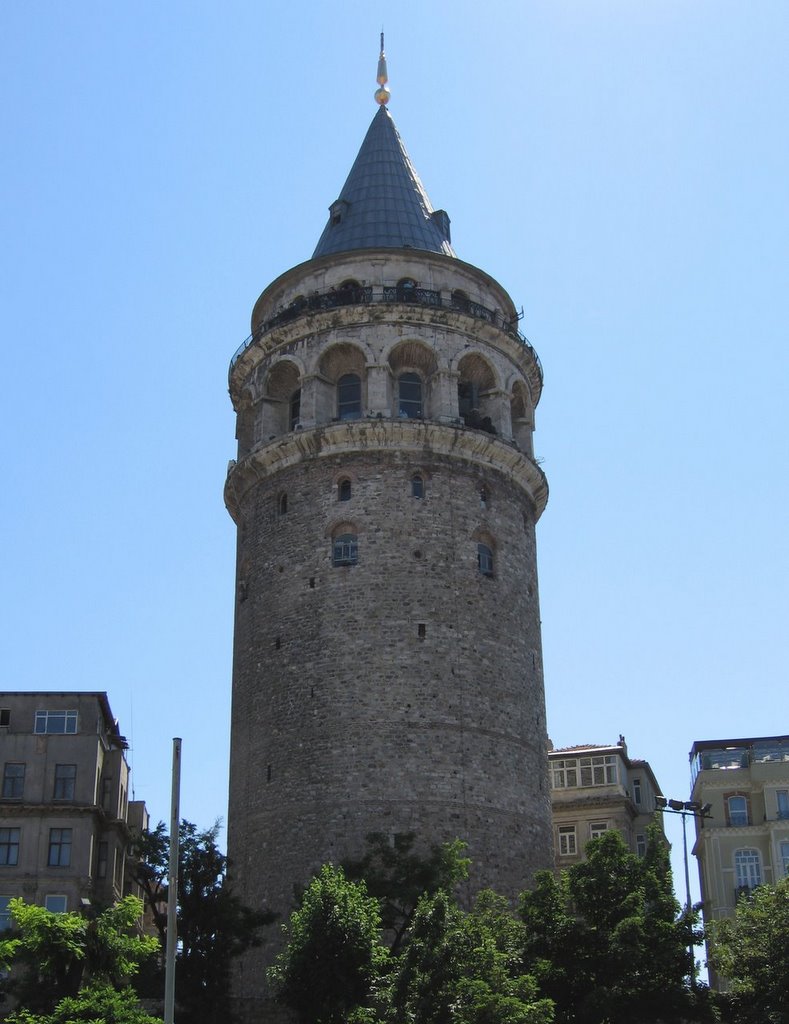 The Galata Tower, built by the Genovese on the Bosporus across from Constantinople during the crusades. Their shared control over the Bosporus opened up the lucrative Oriental trade and allowed them to plant colonies along the Black Sea.
An example of the use of exchange rates to incorporate interest was the "dry loan" which structured interest as a transport charge commonly used in a "wet loan" which were normally paid off in a distant city as a way of transmitting money. Church leaders recognized many of these ruses and complained, but since Genovese municipal judges were, like the rest of the Genovese community, staunch advocates of freedom of contract, and since the Church was dependent on Genovese power (for example to transport and protect crusaders and pilgrims on the seas), the judges winked at these ruses and the Church mostly did not crack down on the practice. In the process of developing these ruses the Genovese became creative drafters of commercial contracts and learned to distinguish elements such as risk, loan, and investment that had been bundled together and treated as inseparable in previous eras.
Perhaps the chief Genovese innovation was modern insurance unbundled from credit or investment:
In short succession Genoa developed insurance, insurance pools secured by landed estates, and reinsurance. Exchanges sprang up for trading public debt, commodity futures, and other commercial paper. Bankruptcy law and the settlement of international trade disputes reached new levels of sophistication. Accounting became widespread and double-entry bookkeeping was born. As a result of their cumulative breakthroughs in institutions and technology, Europeans became the first merchants to travel and trade around the entire globe.Medieval Genovese merchants, like their Venetian rivals, traveled from Iceland to China. Later Genovese such as Christopher Columbus would lead exploration of the New World.
Insurance developed out of an ancient form of marine finance, a loan that only had to be paid back if the ship returned safely:
The earliest risk-pooling insurance contracts were structured similarly to, and enforced under the same legal principals as, loans. Indeed they bundled a loan from the combined investor/insurer with an insurance clause -- in the event that the ship was wrecked, the loan need not be paid back. In 14th century Genoa, we see the separation of the investor from the insurer, via a contract with its conditional clause but requiring no initial loan. Investment contracts became separate entities and could be contracted with different parties, greatly improving the spreading of risk for these ventures. Such improved risk management was crucial for the explosion of overseas trade that Europe initiated over the succeeding centuries.One of the most innovative families were the Vivaldis. Frederico Vivaldi was the one of the first merchants to be insured in the new way, and we still have some of his insurance contracts. His ancestors Vandino and Ugolino Vivaldi were famous merchants and explorers of the west coast of Africa, pioneering new discoveries and a lucrative trade that would be exploited much more by the Portuguese starting in the 15th century, taking advantage of its naval control over the Straights of Gibraltar (which Genoa never clearly gained, since before the Portuguese conquest of Ceuta Muslims controlled both shores). Today the University of Genoa sits on the Via Vivaldi, named after this most adventurous of families.
 The Genoan topography helped it protect warehouses full of goods, Genoa's main source of wealth, as well as its populace.
Another famous Genovese family was the D'orias. Tedesio D'Oria funded the Vivaldi brothers in their last voyage, an ill-fated attempt at the end of the 13th century to pioneer a route to India -- a feat not accomplished until about two hundred years later by the Portuguese. In the attempt they may have (re)discovered the Canary Islands, which in any case the Genovese would colonize by the middle of the 14th century. Andrea Doria was the most famous Genovese admiral, responsible for defeating the Turks in the naval battle of Lepanto, among other feats.
Genoa was also the birthplace of corporations traded by shares, the prototype for the later English joint-stock corporation. Like many of the early English joint-stock companies, most of the Genovese companies were colonial companies that derived their revenue from tribute, tax, and trade from the many colonies they established:
The medieval organizations that most resembled later joint-stock corporations were the Genovese maone. These bore some strong resemblances to the publicani tax farming corporations of the Roman Republican era, although it is not clear how they could have survived the intervening Late Empire and Dark Ages other than as very obscure (and perhaps now lost) written descriptions. In form and function maone also bore strong resemblances to some early joint-stock companies such as the Bank of Amsterdam, Bank of England, and the Dutch and English East India Companies.Genoa was limited in its naval endeavors because Muslims, and then by the end of the 15th century the Portuguese and Spanish, controlled the Straights of Gibraltar. The Genovese nevertheless supplied several leading navigators of the great Age of Exploration, including Nicoloso da Recco, Lanzarotto Malecello, Antoniotto Uso di Mare, Christopher Colombus and probably the Cabots. Its merchants also played a leading role in investing in Spanish and later English endeavors. But with the Reformation the center of commercial innovation would move from Italy to the Netherlands and England. Those innovators stood on the shoulders of giants, and the biggest such giant had been Genoa.Palazzo San Giorgio (St. George). The Bank of San Giorgio (est. 1407) came to handle most of the municipal debt, providing a prototype for later central banks such as the Bank of Amsterdam and the Bank of England.
The Italian cities often sold off their tax receivables to wealthy merchants at a discount as a way to borrow funds. (Discounting was one of the many ways late medieval financiers avoided the rather lax and formalistic usury restrictions that remained in Genoa). The debts were divided into equal shares called loca or partes. Legally, these debt shares were personal property (chattels) and could be freely traded.
Technically, no organization was created when the city sold its tax receivables to merchants. However, to effectively collect the taxes, the holders of loca formed an organization called a maona or societas comperarum. This organization would then subcontract to tax farmers to collect the taxes. By the fourteenth century, Genovese maone also engaged in military conquest and colonization. These were, quite literally, corporate raiders.Il borsa (the Exchange). Genoa pioneered in issuing and trading shares of ships and of municipal and corporate debt.
Normally, maone were temporary, but some of them ended up lasting for a long time. In 1346 the Maona di Chio e di Focea (a company for managing the taxes of Chios and Focea) was formed. This organization's members obtained from Genoa the exclusive right to collect taxes from Chios (an Aegean island) and Phocaea (a port on the Anatolian coast). But first the company would have to conquer them! Although technically a temporary organization, it lasted until 1566.
Rather than going to buy receivables from Genoa, subscriptions to the di Chio e di Focea's loca shares (still legally debt, but to be paid out in dividends as taxes and trading revenues were collected) went to fund 29 galleys to conquer Chios and Phocaea. The Genovese Republic, for a fee, granted the organization exclusive rights to collect taxes from the conquered territories as well as special trading privileges. The conquests, taxes, and trading were at least partially successful, and by the 16th century more than 600 persons owned loca of this maona. This function and some of this structure would later be emulated by the Dutch and English India Companies, but with a basic legal difference -- "shares" in these later joint-stock companies would constitute ownership (like ship shares) not debt as with the maona.


 Flag with traditional English symbols: gryphons and cross of St. George. More importantly, England borrowed and improved upon many Genovese commercial innovations, ushering in the modern era of global trade and the industrial revolution.
England was strongly allied with Genoa throughout much of the Middle Ages. It is thought by some that English symbols such as the Cross of St. George and the gryphon derive from this alliance. English ships flying the Cross of St. George in the Mediterranean were protected by Genovese fleets. More importantly, England derived many of the institutions most critical to the development of overseas trade and colonies and domestic industry from Genoa. England, like the Genovese and Portugal (and unlike many other powers of the time such as China) put their navy primarily on the task of protecting its merchant marine. Its joint stock corporations, many of them colonial, derived from the Genovese colonial companies with their interests divided into shares. Lloyd's of London, with "Names" putting up their estates as collateral for reinsurance, still has the same basic structure as the marine insurance pools pioneered in the 14th century by the Genovese.
Patterns of integrity
One of my main interests is the history of institutions, and in particular the patterns that recur in successful institutions. These organizational structures and security mechanisms allow naturally suspicious strangers to interact with integrity.
These patterns include tamper evidence, shared time, unforgeable costliness, separation of duties, the principle of least authority, risk sharing, and learning from our ancestors, among many others. These patterns have been useful for centuries, and (I can report after having spent many years working in the computer network security field) continue to be useful in the Internet era.
These patterns include tamper evidence, shared time, unforgeable costliness, separation of duties, the principle of least authority, risk sharing, and learning from our ancestors, among many others. These patterns have been useful for centuries, and (I can report after having spent many years working in the computer network security field) continue to be useful in the Internet era.
Reruns
Unenumerated is going into reruns season. For the next few weeks I will be reposting the best articles from this blog. These will mostly be posts from previous years, so unless you have been a reader since the beginning or have read most of the archives many of these will be new to you.
Most blogs discuss the news or similar ephemera and for them reruns would be silly, but this blog mostly discusses issues of historical or otherwise long-term importance, and I will only be rerunning those kinds of articles. If you haven't read a particular old article from Unenumerated yet it will be as informative and entertaining today as when it was first posted.
I will probably have "theme weeks" where this blog will run several classic articles on a particular theme (jurisdiction, legal/political procedure, property, contracts, money, traditional security, online security protocols, media, etc.).
Subscribe to:
Posts (Atom)